



Dips Took the Blame. Load, Depth, and Setup Deserve It.
Dips get blamed for rotator cuff pain the way squats get blamed for knee pain. The movement looks aggressive, so it becomes the prime suspect when something hurts. After years of digging through shoulder mechanics, EMG work, and training logs, I focus on three variables that matter more than the exercise choice: load, depth, and setup. This is not a rehab protocol. If you have a diagnosed cuff injury or shoulder pain that won't settle, see a physical therapist before you load it. If your shoulders are healthy but cranky, this is about building capacity without dropping a movement that can make your upper body stronger.
Why Dips Went From Standard to Suspicious
Parallel bar dips anchored gymnastics and military fitness tests for decades. They were a standard pressing movement. Then the shoulder impingement wave swept through training culture and any loaded behind-the-body position got flagged as a threat. Dips got lumped in with upright rows and behind-the-neck presses. The exercise stayed the same. The conversation around it changed.
Current shoulder rehab thinking leans on load tolerance and graded exposure. A movement becomes painful when the load and range you apply exceed what the tissue can handle and recover from. Dips place the shoulder in loaded extension, which asks a lot from the rotator cuff and the front of the shoulder capsule. That demand is the point. You build capacity by dosing it. Avoidance keeps the capacity gap in place.
What the Rotator Cuff Actually Does During a Dip
Your rotator cuff is four muscles: supraspinatus, infraspinatus, teres minor, and subscapularis. Their job is to keep the ball of the humerus centered in the socket while the pecs, delts, and triceps generate force. During a dip, your shoulder moves into extension as your elbows bend and your body lowers. The cuff muscles co-contract to prevent the humeral head from drifting forward and jamming the front of the joint. That end-range extension position is exactly where many lifters feel tight or pinchy.
The sensation often gets labeled impingement, but in a healthy shoulder it reflects tissues working near their current limit. EMG work on pressing movements shows the cuff fires throughout the range to maintain joint centration. It does not need to be the prime mover to be doing real work.
Depth, Width, and Volume Drive Most of the Stress
Most fixed dip stations let you lower until your shoulders sink below parallel. That depth stretches the front shoulder to its limit. A controlled dip to a point where your upper arm is roughly parallel to the floor, or slightly above, still loads the triceps and chest without taking the cuff past its trained range. Depth is the first variable to control when a dip hurts.
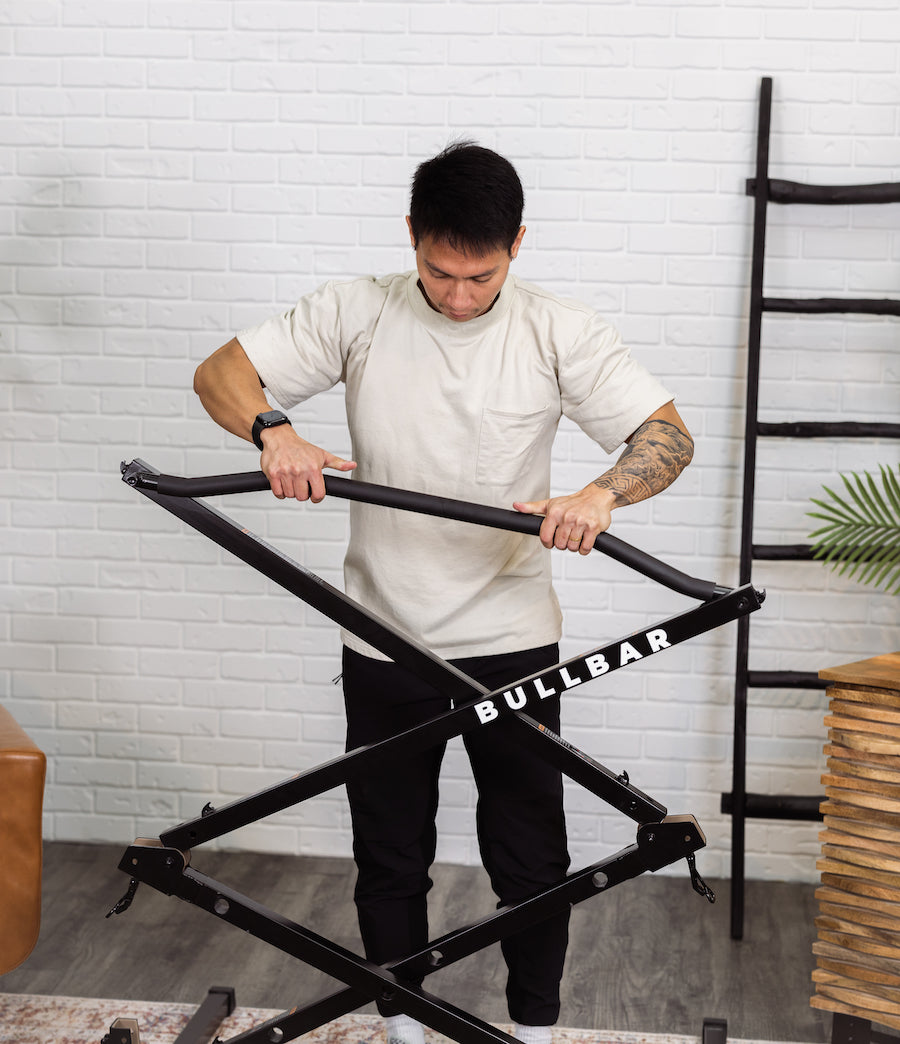
A station with fixed parallel bars locks you into one hand spacing. If that spacing is too wide for your shoulder structure, the humerus works in added abduction and extension. If it is too narrow, the wrists and elbows absorb the mismatch. Adjustable handles let you find the width where your forearms stay vertical and your shoulders feel stacked. The BULLBAR 2.0 adjusts its dip bars from 21 to 24 inches apart and offers three height settings.
Dips often get added on top of bench pressing and push-ups. The cuff and front delt do not track which movement produced the stress. They track total volume. Adding deep dips to a week already heavy on pressing creates a recovery problem.
How to Rebuild Dip Capacity Step by Step
- Support holds. Grip the bars, lock out your elbows, and hold the top position for 20 to 30 seconds. Keep your shoulders down and back, not shrugged to your ears. This builds the baseline isometric strength the cuff needs before you add movement.
- Slow negatives. Jump or step to the top, then lower yourself over three to five seconds to a depth you can control without pain. Stop before your shoulder grinds or pinches. Push back up or use your feet to assist. Do three to five reps.
- Partial ranges. Work the middle and lower-middle range before you chase a full-depth rep. A half rep performed with control builds more shoulder capacity than a full rep that fell through the bottom. Many lifters who can bang out twenty sloppy half reps cannot hold a ten-second controlled descent into a full dip. The missing half is the part that builds the cuff.
- Pause before you progress. Only when you can pause for two seconds at your current bottom position without losing tension should you add depth. Progress in small increments. If your bar has height adjustments, use them.
Dips Belong in a Shoulder-Resilient Week
Match each dip set with a row or face pull set. Add direct external rotation work with a band or light dumbbell twice a week. Train dips twice a week, keep total dip volume between six and ten working sets, and leave at least one day between sessions.
If your shoulders feel better week over week, add depth or load. If they feel worse, reduce depth before you reduce frequency. The goal is to expand the range your shoulders can own, not to prove anything on a fixed station.
Your Setup Should Match Your Shoulders
If your current dip setup forces one width, one height, or a depth that punishes your shoulders, the tool is limiting your training. The BULLBAR 2.0 is a freestanding pull-up bar and dip station that folds down in under a minute and gives you adjustable dip bars from 21 to 24 inches apart across three height settings. No drilling, no permanent rig, no doorway bar that flexes under real weight.
Try BULLBAR for 100 days, risk-free. Free 3-5 day U.S. shipping and a lifetime limited warranty. Get the BULLBAR 2.0 here.
You weren't built in a day. Neither are shoulders that can dip without complaint.
Share
