



Before the Bench Press, Dips Built Pressing Power. They Still Do.
If you spend any time in a commercial gym, you'd think the bench press was the original test of upper-body strength. It wasn't. Before padded benches and power racks became standard, strongmen and gymnasts built pressing power on parallel bars and rings. Dips were the main event, not an afterthought. Somewhere along the way, we traded that movement for a bar and a bench. I'd argue the dip is the more honest test. Your shoulders and triceps are paying for it.
The bench press got popular for a reason. It loads easily, and you can add five pounds a week without learning much skill. Powerlifting federations standardized it, and gyms followed. That's history. But the bench never replaced what a dip gives you. It just became easier to sell.
Why the Bench Press Took Over
In the first half of the 1900s, physical culture leaned hard on gymnastics and calisthenics. Parallel bars were common in training halls. The bench press existed, but it wasn't the default measure of pressing strength. As organized powerlifting grew after mid-century, the bench press became one of the three competitive lifts. It rewarded incremental loading and easy judging. Gyms built their programs around it. Dips slid into a supporting role. Trainees stopped learning how to control their body through space.
What the Bench Press Can't Give You
A bench press pins your shoulder blades to a pad. You push the bar while your back stays braced. A dip leaves your scapulae free. They have to move and stabilize as you lower and press. Your core and glutes hold tension. The range of motion at the shoulder can go deeper than a bar touching your chest. You train pressing strength with active shoulder control.
In a dip, the triceps drive elbow extension. The anterior deltoid and pectoralis major assist. Because your shoulder blades tilt and rotate through the movement, you build strength in positions the bench never visits. That transfer shows up when you push yourself over a ledge, climb, or press through parallel bars. A bench press, for all its value, leaves your lower body out of the equation.
Start With Control, Not Depth
Do not chase deep dips on day one. Build the range you own. Start with what you can control.
- Hold the top position for 20 to 30 seconds with arms locked and body tight.
- Lower yourself for 3 to 5 seconds. Keep the movement slow.
- Press back up with a band under your knees or feet if you need help.
- Once you can perform five strict reps, build volume before adding weight.
Hand spacing matters. Keep your hands about shoulder width. A grip that is too wide puts the shoulder in a less forgiving position. Lower until your upper arms approach parallel or slightly below, only as deep as you can control. Use a three-second descent and a one-second pause at the bottom. Press without bouncing. If you have a history of shoulder pain, check with a qualified coach or physical therapist before adding heavy dip work.
Programming Dips as a Main Lift
Dips tax the triceps and shoulders. Treat them as a primary upper-body press, not an accessory. Two or three sessions per week works for most trainees. A simple setup: three to five sets of five to ten reps, leaving one clean rep in reserve on most sets. Pair dips with pulling work in the same session to keep the shoulder balanced.
Weighted dips come after you own strict bodyweight reps for sets of ten. A dip belt or weighted vest works well. Do not add load until your technique is stable. Ten focused minutes, three days a week, beats one long session you cannot repeat. Consistency moves the needle more than intensity.
Training Dips at Home Without a Permanent Rig
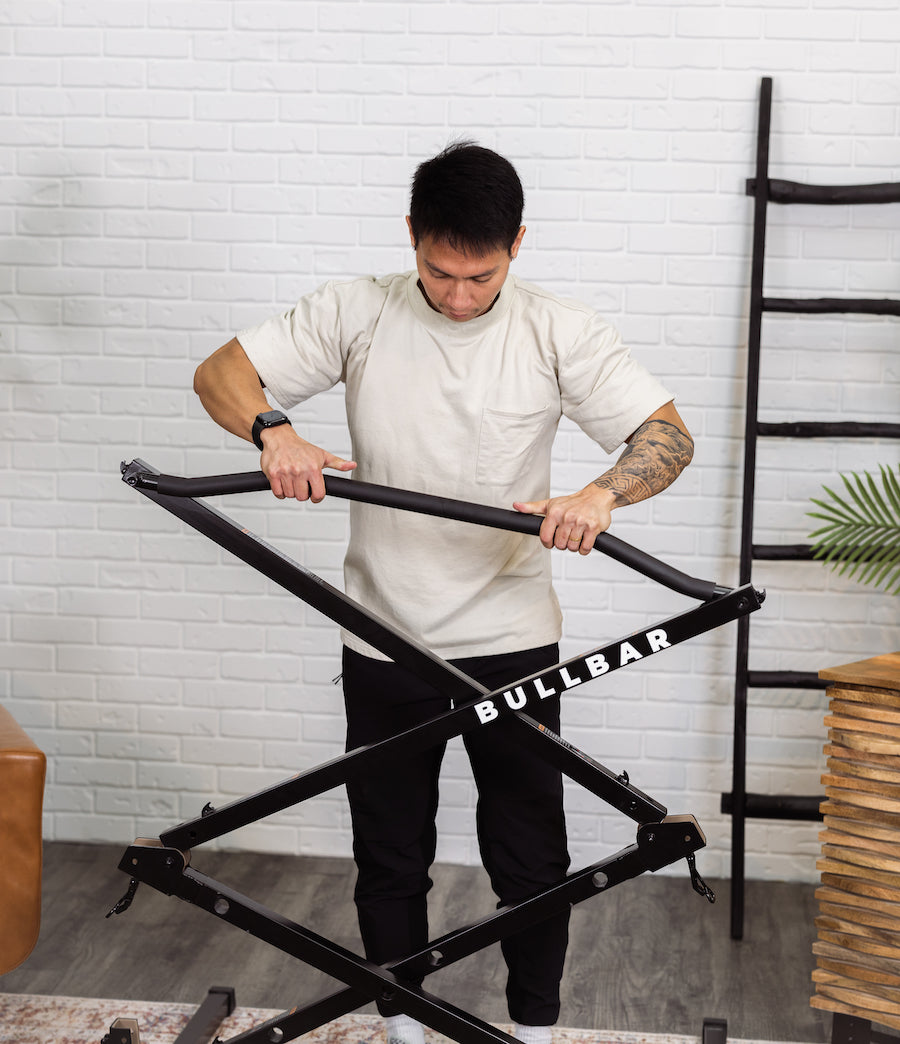
A freestanding pull-up bar and dip station removes the last barrier. BULLBAR 2.0 gives you parallel dip bars with three height settings and adjustable distance from 21 to 24 inches. That adjustment matters because shoulder width is not one size fits all. The open portal design means no center post or back pad to restrict your range. The frame is rated for 400 pounds and was tested through over 1,200 continuous rep cycles. When you are done, it folds to 45 by 13 by 11 inches. No drilling, no assembly. You set it up in under a minute and store it out of the way.
Dips built pressing power before the bench press existed. They still do. You need a tool that lets you train them consistently at home. Try BULLBAR for 100 days, risk-free. Free U.S. shipping in 3 to 5 days and a lifetime limited warranty. Shop BULLBAR 2.0.
You weren't built in a day. Ten minutes of focused work, repeated, gets you closer every week.
Share
