



Forget Bench Dips: Own the Support Hold to Earn Your First Strict Dip
Someone asks how to get a first dip and the usual answer comes fast: put your hands on a bench behind you, lower your hips, press back up. It burns the triceps and feels like work. I have watched that exercise fail more beginners than it helps because it trains a pattern you then have to unlearn.
A strict parallel bar dip is a different movement. Your shoulder stays closer to neutral, your scapula presses down to create a stable base, and your torso can find the forward lean that fits your arm and leg length. A bench dip keeps your shoulder extended behind your torso and tips the shoulder blade forward. The range is short and the torso angle is locked. You get stronger at bench dips. You do not get stronger at supporting yourself on parallel bars.
I have seen training logs where someone can do 25 push-ups and 15 bench dips, then cannot hold a top dip position for ten seconds. That gap is a skill gap. It comes from skipping support practice.
Own the Top Position Before You Press
Set your dip bars so your wrists sit under your elbows. Grip the handles and press your shoulders down away from your ears. Lock your elbows without snapping them back. Squeeze your glutes, brace your abs, and point your toes. Hold that position.
It looks simple. It isn't. Most beginners start shaking after ten seconds, and that shake is your nervous system learning to coordinate the shoulder girdle, trunk, and hips under load while your hands stay glued to the bars and your feet hang beneath you.
Train the hold until you own it. Start with three sets of twenty to thirty seconds and rest sixty to ninety seconds between sets. Once you can hold thirty seconds without your shoulders creeping up, move to slow negatives.
Four Steps That Build on Each Other
- Top support hold. 3 sets of 20 to 30 seconds. Rest 60 to 90 seconds between sets.
- Slow negative. Start at the top. Lower yourself over 3 to 5 seconds. Step back up or use your feet on a box to return to the top. Do 3 sets of 3 to 5 reps.
- Partial dip. Lower to about 90 degrees of elbow bend, pause for one second, then press back up. Do 3 sets of 5 reps.
- Full strict dip. Lower under control until your shoulders reach roughly elbow height or you feel a strong stretch in the chest and front shoulder. Press back up. Work up to 3 sets of 5 to 8 reps.
Use assistance only after you can control the negative. A band under your knees can help, but it should come after the slow negative is clean.
A Simple Week of Beginner Dip Training
Run this schedule two or three days a week with at least one rest day between sessions. Warm up with arm circles, scapular push-ups, and band pull-aparts first.
- Day 1: 3 x 20-second top support hold; 3 x 3 slow negatives. Rest 90 seconds between sets.
- Day 2: 2 x 20-second top support hold; 3 x 5 partial dips with a one-second pause at the bottom. Rest 90 seconds between sets.
- Day 3: 2 x 20-second top support hold; 3 x 4 slow negatives; 2 x 3 partial dips. Rest 60 seconds between sets.
On the other days, train rows, pull-ups, or core. The shoulder capsule and triceps need recovery, so two to three dip sessions per week are enough for most beginners.
Mistakes That Stall Progress
- Shoulders creeping up to your ears. You lose the stable base and shift stress to the neck and shoulder capsule. Go back to top holds and press down harder.
- Bouncing out of the bottom. Momentum hides the fact that you are weak in the stretched position. Pause one second at the bottom of every rep.
- Stopping above parallel. A half dip keeps tension in the triceps and elbows but skips the chest stretch. Lower until you feel a stretch in the chest and front shoulder, without pain.
- Training dips every day. The supporting muscles are small and need rest. Two to three sessions per week are enough for most beginners.
If you feel pinching in the front of the shoulder, stop and adjust. That may mean reducing depth, changing your torso angle, or getting an assessment from a professional.
What You Need at Home
You need two parallel bars that stay put. A freestanding pull-up bar and dip station gives you that, and it leaves enough room for your knees and torso to move without hitting a center post.
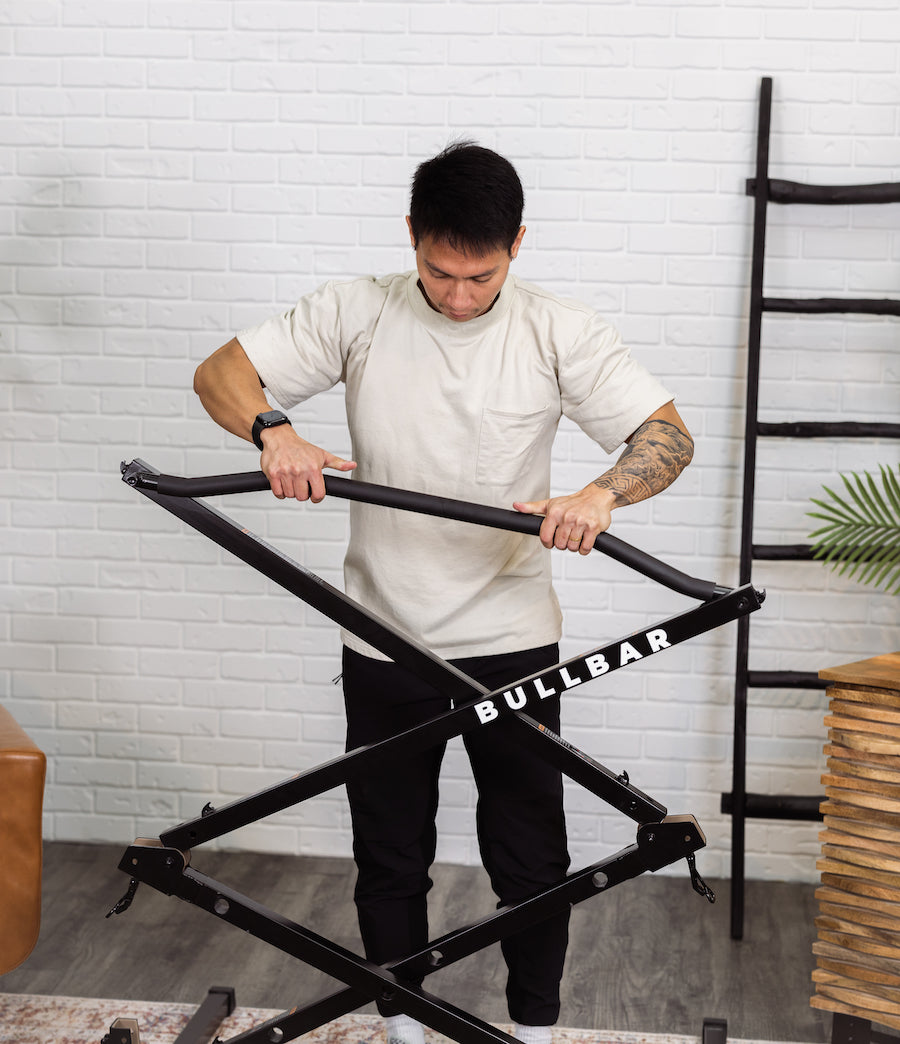
The BULLBAR 2.0 includes adjustable dip bars with three height settings and 21 to 24 inches of grip spacing. Its open portal design removes the center post and back pad, so your body can lean forward the way a strict dip demands. The frame is built from 16-gauge industrial steel, holds up to 400 pounds, and has been tested through 1,200 continuous rep cycles at that load. It folds down to 45 by 13 by 11 inches and sets up in under a minute with no tools. You focus on the hold, not on bracing the gear.
Hold Still First, Then Earn the Rep
Your first strict dip comes from owning the top position, lowering with control, and building range over weeks. Skip the bench dip as your starting point. Start with support holds, then slow negatives, then partials, then full reps. Hold still first. The pushing will follow.
Try BULLBAR for 100 days, risk-free. Free 3 to 5 day U.S. shipping and a lifetime limited warranty.
Share
