



Leaning Dips: Why the Forward Lean Is the Point, Not the Flaw
You already know the dip. Grab the bars, lower yourself, press back up. What nobody tells you is that the angle of your torso decides whether that movement builds your chest or just wears out your triceps. Lean forward and the load shifts. Stay vertical and you're doing a different exercise entirely.
The Upright Dip Comes From Gymnastics, Not Chest Training
Parallel bars have been part of men's Olympic gymnastics since 1896. Judges reward a straight body, locked elbows, and minimal swing. A forward lean costs points. Strength coaches later borrowed the dip for muscle building, and most kept the upright standard without asking whether it served the same goal.
By the middle of the twentieth century, bodybuilders were doing bench dips with a forward lean because that angle loaded the pecs. Magazine write-ups included the lean as part of the instruction. Somewhere along the way, gym culture flattened the movement into one form: chest up, torso vertical, elbows tucked. That version produces a strong triceps dip. It won't build your chest the way a forward lean will.
What Changes When You Lean
At the bottom of an upright dip, your shoulder extends behind your torso and your elbow flexes. Your triceps brachii gets a long stretch and drives most of the load on the way up. Tip your torso forward 20 to 30 degrees and your shoulder moves into a flexed and horizontally adducted position. That gives the sternal head of your pectoralis major a better line of pull. Your elbow still extends, but your chest now contributes through a much longer range instead of handing the finish to your triceps.
Quick test. At the bottom, look at where your sternum sits relative to your hands. Sternum over your hands means you're leaning enough to hit the chest. Head behind your hands means you're doing a triceps dip. Both are useful. They are different exercises.
Make the Lean Your Default for Chest Work
Push-ups build chest because your torso is horizontal and your hands press toward the floor. A dip becomes a chest builder when your torso leans forward enough to approximate that angle. If you only train upright dips, you're leaving chest growth on the table and then wondering why your triceps grow while your chest doesn't.
Treat the lean as a training variable. A slight lean of 10 to 15 degrees keeps the movement mostly triceps. A stronger lean of 30 degrees or more puts your chest in the driver's seat. More lean also loads the front of your shoulder, so pick your angle based on your mobility and how your shoulders feel that day.
How to Set Up a Leaning Dip Without Trashing Your Shoulders
Start at the top with elbows locked and shoulders pulled down away from your ears. Set your scapula. Then tip your whole torso forward as one unit. Don't drop your head and neck. Keep your ribs stacked over your pelvis and brace your core. Lower until your upper arm is parallel or just below. Keep your forearms vertical and let your legs drift behind you.
Two common mistakes to avoid:
- Staying upright while bending only your neck. That does nothing for the chest and loads the cervical spine.
- Flaring your elbows to 90 degrees. A little flare is normal, but 80 to 90 degrees can overstress the front of the shoulder.
If you feel a pinch in the front of the shoulder, shorten the range or reduce the lean. The dip is not a movement to force through pain. Regress to a bench dip or a band-assisted dip until the range feels clean. Some people don't have the shoulder structure for deep forward-leaning dips, and that's fine. Use the angle you can own. If pain persists, see a qualified coach or clinician.
Programming the Leaning Dip
Leaning dips work as a primary chest movement in a bodyweight split. Start with four sets of 8 to 12 reps after a real warm-up. Use a three-second negative on the first two sets to increase time under tension without adding weight. Keep the bottom position brief, then press back to the top with control.
If you can't do five clean reps, use a three-second negative and step back up, or place a band under your knees. Once you can complete all four sets with 12 controlled reps, add a one-second pause at the bottom. After that, add a weight vest or a dip belt with a light plate. Increase load only after you can own your current angle with clean form.
Change one variable at a time:
- More lean
- More depth
- More tempo
- More load
Pick one. Run it for three weeks. Assess. Then change the next.
Where a Freestanding Bar Helps
The leaning dip needs room for your torso to travel forward. A doorway pull-up bar gives you nothing to dip on. A power tower often blocks you with a center post or a back pad. A freestanding pull-up bar and dip station with an open portal design leaves space in front, so you can lean without hitting anything.
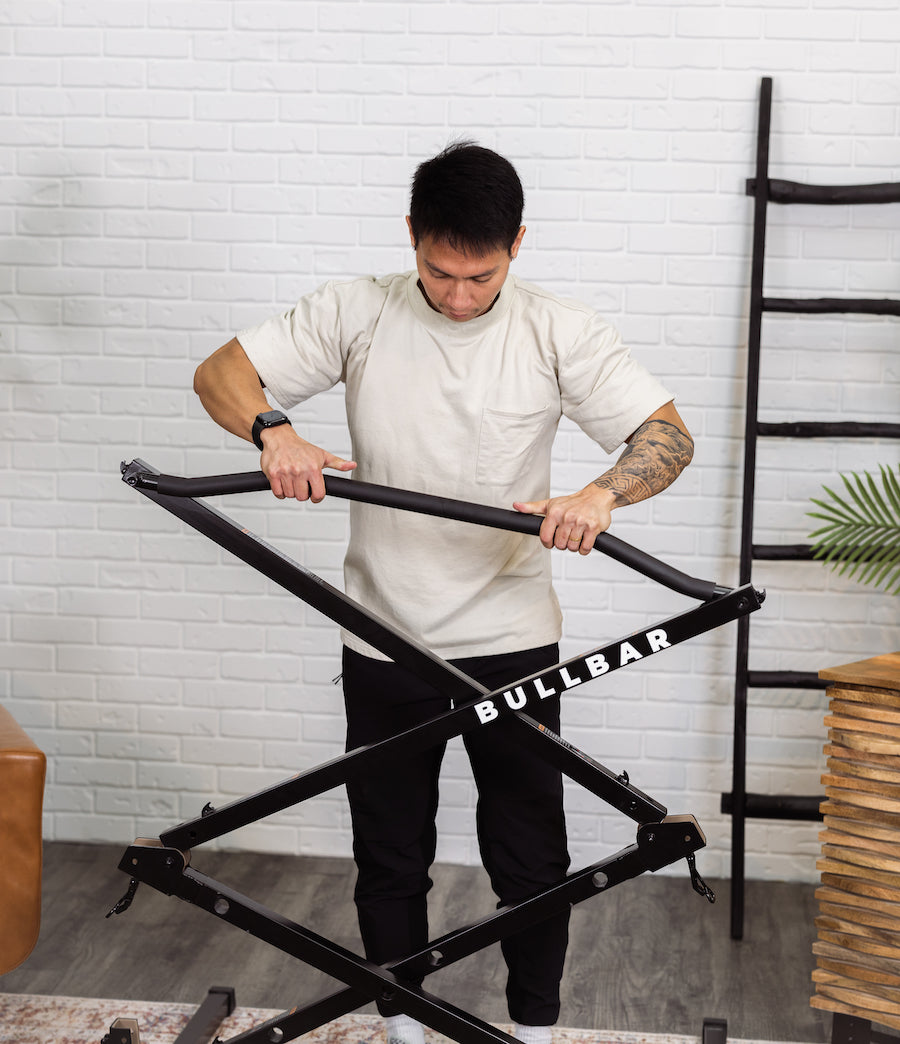
The BULLBAR 2.0 is built this way. The dip bars adjust between 21 and 24 inches apart and offer three height settings. The frame has no center post and no back pad, so your chest and hips can move through a full range without obstruction. It folds flat when you're done, but while you train, it gives you room to find the angle your chest needs. Try the BULLBAR 2.0 for 100 days, risk-free. You get free 3 to 5 day U.S. shipping and a lifetime limited warranty.
Train the angle that builds what you came to build.
Share
