



Measure Before You Mount: Setting Dip Bar Width to Your Skeleton
Most dip station advice skips one step: take a tape measure and find the bony bump on top of your shoulder. That bump is your acromion, and it tells you where your shoulder joint sits under load. Set the bars too wide or too narrow relative to that bone, and your elbows, wrists, and shoulder capsule will let you know in a few weeks. Sometimes the sign is a dull ache at the front of the shoulder. Sometimes it's a pinch at the bottom of the rep.
"Shoulder-width apart" is the phrase everyone repeats, but it hides three different measurements. There's the outside edge of the deltoid, the inside crease of the armpit, and the bone width. A broad-shouldered lifter can have a narrow acromial width, a narrow-looking lifter can have a wide one, and neither the size of the deltoid nor the width of the shoulders on a photo tells you where the joint sits when your full body weight hangs on the bars.
Fixed Bars Assume One Skeleton
Most gym dip stations weld the bars at a single width. That width came from someone's design template, not your body. In a push-up, your wrists and elbows can adjust independently. On a dip station, the bars lock your hands in place. Any mismatch between bar width and shoulder width then shows up at the wrist and the front of the shoulder. Every rep loads your full body weight through that mismatch.
A fixed bar set wide relative to your acromion forces the elbow out, twists the wrist a few degrees, and stretches the shoulder capsule under full body weight. Repeat that three times a week for a month. The soreness is not from weakness. It's from geometry.
Measure the Bone, Not the Muscle
Stand with your back to a wall. Find the flat bony edge on top of each shoulder. Run a tape measure across your upper back from one edge to the other. That number is your acromial width. Use it as your starting point for dip bar spacing.
Set the bar centers directly under each acromion. From there, bring the bars in an inch for a triceps-dominant dip. Move them out an inch to let your chest get a deeper stretch, but only if your shoulder stays quiet. The range is small because the shoulder capsule doesn't tolerate much deviation.
Let's say your acromial width measures 16 inches. A fixed bar at 22 inches places each hand three inches outside the joint line. Three inches changes the elbow path enough to matter. If your acromial width is 19 inches and the fixed bar is 21 inches, the hands sit too close. The elbows tuck hard, and the wrist flexes into a position it was never built to hold under load.
Height and Torso Angle Do the Other Half
Width matters, but height decides if you can hit full depth. Bars set too low force you to bend your knees into a cramp or cut the rep early. Bars set too high force you to jump into every set. The first rep starts from a lockout you did not earn, and your position drifts from the start.
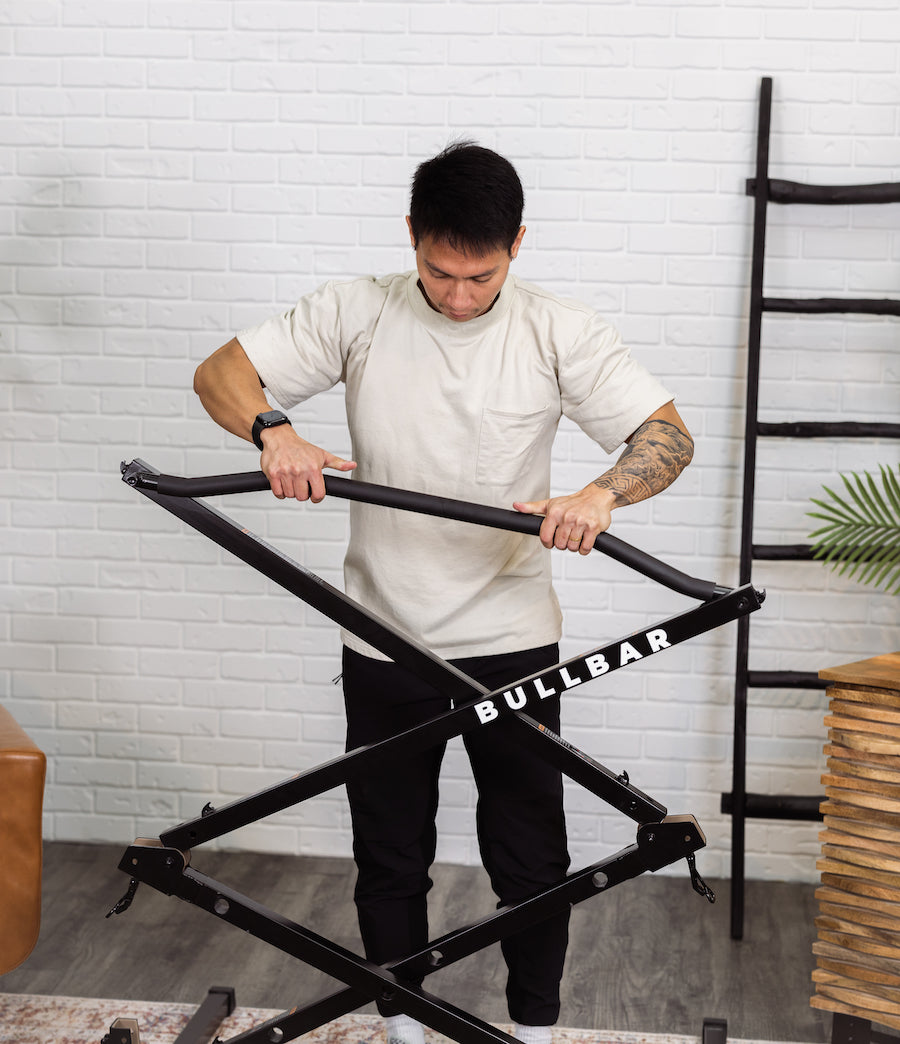
Set the bars high enough so your feet clear the floor at the bottom of a full dip while your knees stay bent. You should be able to step into the support or push off once, not launch. The BULLBAR 2.0 includes three height settings for this reason. A fixed frame can't change for your leg length.
Torso lean changes the shoulder's relationship to the bar. Lean forward and the chest does more work, but the shoulder moves into more horizontal abduction. If the bar is already too wide, forward lean makes the problem worse. If the bar sits under the acromion, a modest lean stays manageable. For triceps work, stay more upright and use the narrower setting. For chest work, lean forward and let the elbow flare a little. Placement is width plus the angle of your torso and elbows. That combination decides where the stress lands.
Adjustable Bars Make Placement a Training Variable
Fixed stations force you to adapt. Adjustable bars let you adapt the tool. The BULLBAR 2.0's dip bars move from 21 to 24 inches center-to-center, which covers many acromial widths. The three height settings handle different leg lengths and different exercises.
A single frame can match the rep you're doing. Set the narrower position for strict triceps reps and move the bars wider for chest-dominant sessions. Change the height for hanging leg raises or for a training partner of a different height. The BULLBAR 2.0 adjusts to your skeleton instead of asking your skeleton to adjust to it.
Test Before You Load
Placement is a starting point, not a prescription. If you have a history of shoulder instability or pain during dips, a tape measure does not replace a clinician's advice. For some people, dips are not a good choice. That's honest.
Before adding weight, hold the top support position for 10 seconds. If the front of your shoulder pinches, move the bars half an inch and retest. If your elbows complain, stop and adjust. A small width change often fixes the problem because the original setting never matched you.
- Measure your acromial width with a tape measure.
- Set the bar centers within an inch of that width.
- Set the height so your feet clear the floor at the bottom of a full dip.
- Hold the top support for 10 seconds.
- Move the bars narrower for triceps, wider for chest, only if pain-free.
Placement Is Not a Small Detail
Dip bar placement decides whether you build pressing strength or slowly irritate your shoulder joint. Most lifters never think about it because fixed stations never ask them to. Measure the bone. Set the bars. Test the position. Then accumulate reps. You weren't built in a day, and your dip station should not assume you were built to a template. Your joints will tell you if you got it right. So will your training log.
Share
