



Most Dip Bars Are Built Too Wide for Your Triceps
Walk into any gym and the dip station gives you one bar width. You adjust nothing. You accept the geometry in front of you and wonder why your chest keeps growing while your triceps stays the same.
The variable that decides whether a dip builds triceps or chest is the distance between the bars. Most lifters never think about it because most stations never let them change it.
What Bar Width Does to the Movement
The triceps extends the elbow. The long head crosses the shoulder joint and also helps extend the shoulder. A triceps-heavy dip loads elbow extension from a deep bend while the shoulder extends behind the torso. At the bottom, the long head sits in a loaded stretch, with muscle and tendon under tension at a long length. Research on stretch-mediated hypertrophy shows that muscles respond well to tension at long lengths. That is why a correctly set dip builds size that pushdowns rarely match.
The condition is simple. Your forearms stay vertical, your elbows track back, and your hands sit close enough to your body that your pecs cannot take over.
When the bars sit wide, your forearms angle outward and your elbows follow. The movement shifts from elbow extension into shoulder adduction and horizontal flexion. Your pecs own those joint actions. The dip becomes a chest exercise with triceps along for the ride. When the bars sit narrow, your forearms stay vertical, your elbows track straight back, and your triceps performs the work.
Push-up studies that measure muscle activation with surface EMG report the same trade. Narrower hand placement shifts work toward the triceps, while wider placement shifts it toward the chest. Bench press grip comparisons point in the same direction.
Fixed-Width Stations Force a Chest Dip
Most commercial dip stations fix the bar spacing because mass production rewards one width for every body. There is no average body.
Say your shoulders sit around 18 inches wide and the bars are fixed at 24. Your hands start three inches outside each shoulder. From that position, a strict triceps dip asks your elbows to track straight back while your hands want to travel outward. Most lifters lose that fight. The elbows flare, the pecs take over, and the triceps gets a partial stimulus.
A 21-inch setting changes the math. Your hands sit just outside your hips. Your forearms line up vertically under the load. Your elbows track back without a fight. Your triceps owns every inch of the extension. Three inches separate a triceps dip from a chest dip.
A 10-Second Width Check
Stand between the bars and grip them. If your forearms are not vertical at the top, the width is wrong. Lower yourself halfway and watch where your elbows travel. If they flare outward past your wrists, your pecs are taking over. Move the bars one notch narrower and repeat. Your elbows should track back in line with your forearms.
The Long Head Gets a Stretch Pushdowns Skip
The long head of the triceps originates on the scapula. The other two heads cross only the elbow. That difference explains why dips challenge the triceps in a way pushdowns do not. At the bottom of a full-range dip, your shoulder extends behind your body while your elbow stays fully bent. For the long head, that is a loaded stretch.
Pushdowns keep the elbow moving through a short range with the shoulder neutral. Dips take the long head through a range most lifters never train. The tradeoff is that deep dips ask more from your shoulders. If your shoulders hunch at the bottom, you lose the stretch and turn it into a passive hang. Chase tension first. Depth follows control.
A Dip Setup You Can Repeat
- Set the bars to shoulder width or one notch closer.
- Grip with palms facing your sides and wrists stacked over the bars.
- Start at a locked-out top with your shoulders pulled down.
- Lower for three seconds, letting your elbows track behind you.
- Stop when your shoulders draw just past parallel.
- Drive through your palms and lock out hard.
Do not bounce out of the bottom. Do not let your shoulders shrug toward your ears. If you cannot control the descent for three seconds, lower the bars and start there. If you have a shoulder history, start with a shallower range and build depth slowly.
Programming Dips for Triceps Growth
Two direct dip sessions per week is enough for most lifters. The long head work under a heavy stretch produces more soreness than pushdowns, so a third day before you adapt slows recovery and stalls progress.
Day A:
- Dips: 3 sets of 8 to 12 reps. Add 2.5 to 5 pounds when you hit 12 on all three sets.
- Overhead triceps extension: 3 sets of 10 to 15 reps.
Day B:
- Dips: 4 sets of 6 to 10 reps with the same progression.
- Close-grip push-up: 3 sets near failure.
Keep total direct triceps volume at 6 to 9 sets per session. If lockout strength stalls, cut two sets before you add weight.
What Adjustable Width Changes
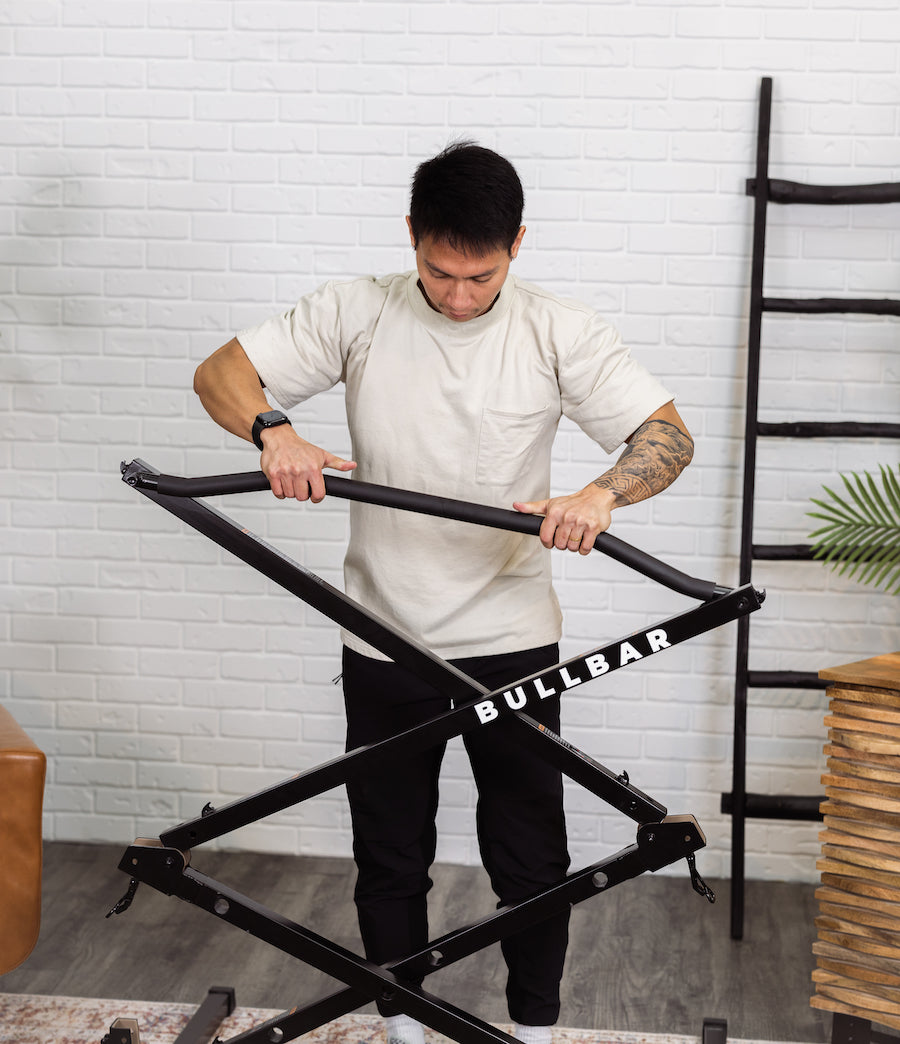
The BULLBAR 2.0's dip bars adjust from 21 to 24 inches. A 21-inch setting suits a lifter with narrow shoulders, while 24 inches serves a broader build. You decide. The 33.5 mm steel bars sit at three height settings. The open portal design leaves no center post or back pad in your way. You set the width to your shoulders, set the height to your range, and train. No assembly. No drilling. No fixed width.
The frame folds to 45 x 13 x 11 inches and supports 400 lbs. It sets up in under a minute. If your current dip station has one fixed width, the machine decides your mechanics, and your triceps pays the price.
Try BULLBAR 2.0 for 100 days, risk-free. Free 3-5 day U.S. shipping and a lifetime limited warranty.
Share
