



The 50-Dip Standard: What 1811 Berlin Gymnasts Knew About High-Rep Dips
Friedrich Jahn opened a training ground at Hasenheide in Berlin in 1811. Among the equipment were parallel bars. Gymnasts pressed, supported, and repeated upper body patterns hundreds of times. The dip wasn't a one-rep max lift. It was a skill you repeated until the session ended. That old approach still works, and most lifters never use it.
High reps didn't always mean easy reps
As powerlifting grew through the mid-20th century, the bench press became the standard test of upper body strength. Dips moved to the end of arm day. Coaches called high-rep dips beginner work or toning. Gym culture equates heavy with effective, and that assumption skipped over what long dip sets do.
What 25 controlled reps change
A strict dip uses most of your bodyweight, which makes the load moderate to heavy for many people. A set of 25 is a long stretch of mechanical tension. Total work climbs fast. The load stays the same. The volume does the work.
A 2017 meta-analysis by Brad Schoenfeld and colleagues, published in the Journal of Strength and Conditioning Research, found that low-load training taken close to failure produced similar muscle growth to heavy-load training. The key variable was how close each set got to failure. For dips, a set of 25 pushed hard can build muscle like a heavier set of 5. You have to earn the reps.
High-rep sets build local muscular endurance too. Your triceps and front delts learn to keep pressing after they want to stop. That work capacity carries over to heavy blocks and any sport that demands repeated upper body effort.
Your tendons adapt slower than muscle. They get less blood flow and rebuild more slowly under repeated load. Controlled eccentrics and full depth expose tendons to repeated tension at manageable loads. If your shoulders hurt, see a qualified professional before adding volume. Gymnasts show what years of dips and support holds do for upper body tendon stiffness.
Programming high-rep dips without wrecking your shoulders
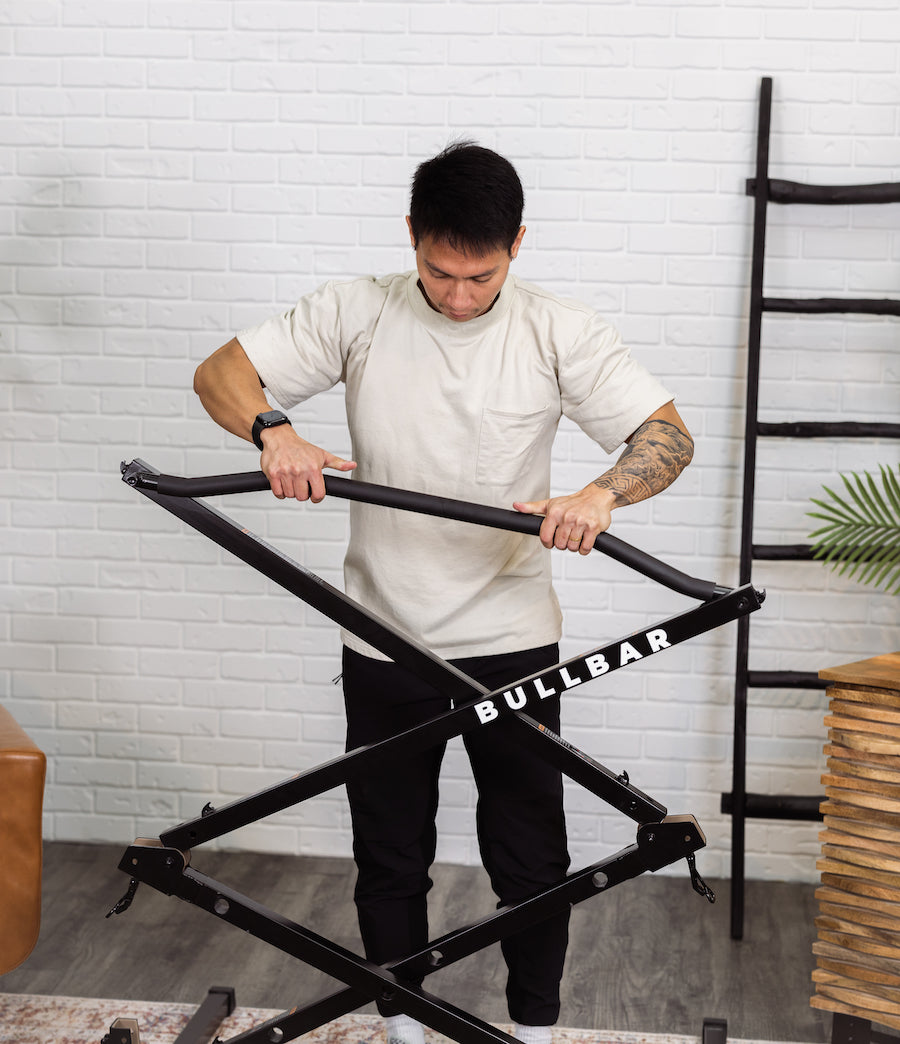
Set the bars at shoulder width or slightly wider. Lower until your upper arm reaches at least parallel to the floor. Keep your shoulders pulled back and down. Don't bounce. On the BULLBAR 2.0, the dip bars adjust from 21 to 24 inches apart and offer three height settings. Narrow grips hit triceps harder, wider grips hit chest. The frame is tested under 400 lbs, so bodyweight sets of 25 are well within range.
Start with a current max set. If you can do 10 strict dips, don't chase 50 yet. Build total volume first.
- Day 1: 5 sets of 6 with 90 seconds rest. Add one rep per set each week.
- Day 2: Density block. Set a timer for 8 minutes and complete as many quality reps as possible in sets of 3 to 5.
- Day 3: Paused reps. Lower over 3 seconds, pause 2 seconds at the bottom, press up. 4 sets of 4.
Stop each set two reps short of failure on high-frequency days. Grinding to failure every time turns a volume tool into a recovery problem. Push closer to failure once a week.
The 50-dip standard
A 50-dip total in under 10 minutes is a practical first target. You don't need 50 unbroken reps. Accumulate them in short clusters.
- Set a timer for 10 minutes.
- Do sets of 3 to 5 strict reps.
- Rest only long enough to keep form clean.
- Count total reps until you reach 50.
When 50 feels easy, push to 75, then 100 in 15 minutes. Add weight only after you own the total with clean reps. High-rep days and heavy weighted dip days work well in the same week. One builds the base, the other builds the peak.
High-rep dips faded because they don't load a barbell and they don't photograph well. But they build the endurance base that makes heavy pressing feel more controlled and the tendon capacity that keeps you training. Start with strict reps. Accumulate volume. Let the total work do its job.
Try BULLBAR for 100 days, risk-free. Free 3 to 5 day U.S. shipping and a Lifetime Limited Warranty. You weren't built in a day.
Share
