



The Assisted Dip Machine Won't Teach You to Dip
You can load 60 pounds of counterweight onto an assisted dip machine, grind out twelve clean reps, and feel like you trained hard. Then you try one bodyweight dip on parallel bars and fold at the bottom. A bodyweight dip demands a different skill than a counterweight rep. That gap shows up the moment the knee pad disappears.
Walk into most commercial gyms and you'll find an assisted dip machine parked near the cable stacks. It has a knee pad, a selectorized stack, and a reputation as the safe path to a first dip. The logic sounds reasonable. Stack a few plates, kneel on the pad, and press through the same range with less bodyweight. That approach looks like progression, but it rarely delivers one.
I've watched this pattern repeat for years. A trainee works down from 60 pounds of assistance to 20, then tries a bodyweight dip and can't hold the top position for five seconds. The missing piece was never triceps strength. The missing piece was practice in the actual dip position.
Where the Assisted Dip Machine Came From
The assisted dip machine is a product of the selectorized equipment boom that reshaped commercial gyms in the 1970s and 1980s. Manufacturers wanted equipment that any new member could use on day one, with no spotter and no foundation of bodyweight strength. Counterweight assistance solved that problem. You knelt on a pad, selected a load, and moved through a guided range. Gyms liked the setup because it kept beginners on the floor and reduced the intimidation of full bodyweight dips.
The tradeoff was specificity. A free dip asks you to support and control your entire body through space. The machine doesn't. That tradeoff still defines the equipment today. The assisted dip machine made dips feel approachable, but it did so by removing the demands that make the movement worth doing. You didn't get a lighter dip. You got a different exercise with a dip-shaped upper body.
What the Knee Pad Actually Changes
In a free dip, your hands support your body. Your trunk, hips, and legs hang beneath you. Every rep asks you to manage forward lean, shoulder position, and lower body movement as one connected unit. The assisted dip machine replaces that with a knee pad that carries a share of your bodyweight and anchors your lower body in a fixed path. That single change has consequences.
The pad stabilizes your legs and pelvis. Your core and shoulders do less work because the machine holds your lower half in place. It also changes the line of force. Instead of your center of mass moving freely over your hands, the pad pushes up on your knees and encourages you to lean into it or bounce off it. You build strength in a movement that no longer resembles the target skill. A knee-supported dip is its own movement, and it transfers poorly.
Why Less Assistance Doesn't Add Up to a Dip
Many lifters treat the assisted dip machine as a progression tool. Select less assistance over time and you'll eventually dip. That logic ignores how the machine changes the task. Reducing the counterweight from 50 pounds to 30 still leaves the knee pad doing the same stabilizing work. You get stronger at a knee-supported dip. A free dip requires a different skill. I've watched lifters hit double-digit reps with light assistance, then struggle to hold the bottom position of a bodyweight dip for five seconds. The missing skill is owning the position without the pad. That skill only comes from practicing without the pad.
A better test before chasing reps on the machine: can you hold the bottom of a dip for 15 seconds? Can you lower yourself for a five-second negative? If not, the machine hasn't built the control you need.
A Better Way to Scale the Dip
You don't need a selectorized stack to make dips accessible. A stable freestanding dip station and a set of resistance bands handle the job better. Loop a band under one knee or foot, and you reduce the load while keeping your trunk and shoulders responsible for the movement. The band gives assistance that decreases as you press up, which matches the strength curve of a dip. It also lets your lower body move naturally, because the band doesn't fix your knees in place. You still have to stabilize. You still have to control the descent. You get a lighter load.
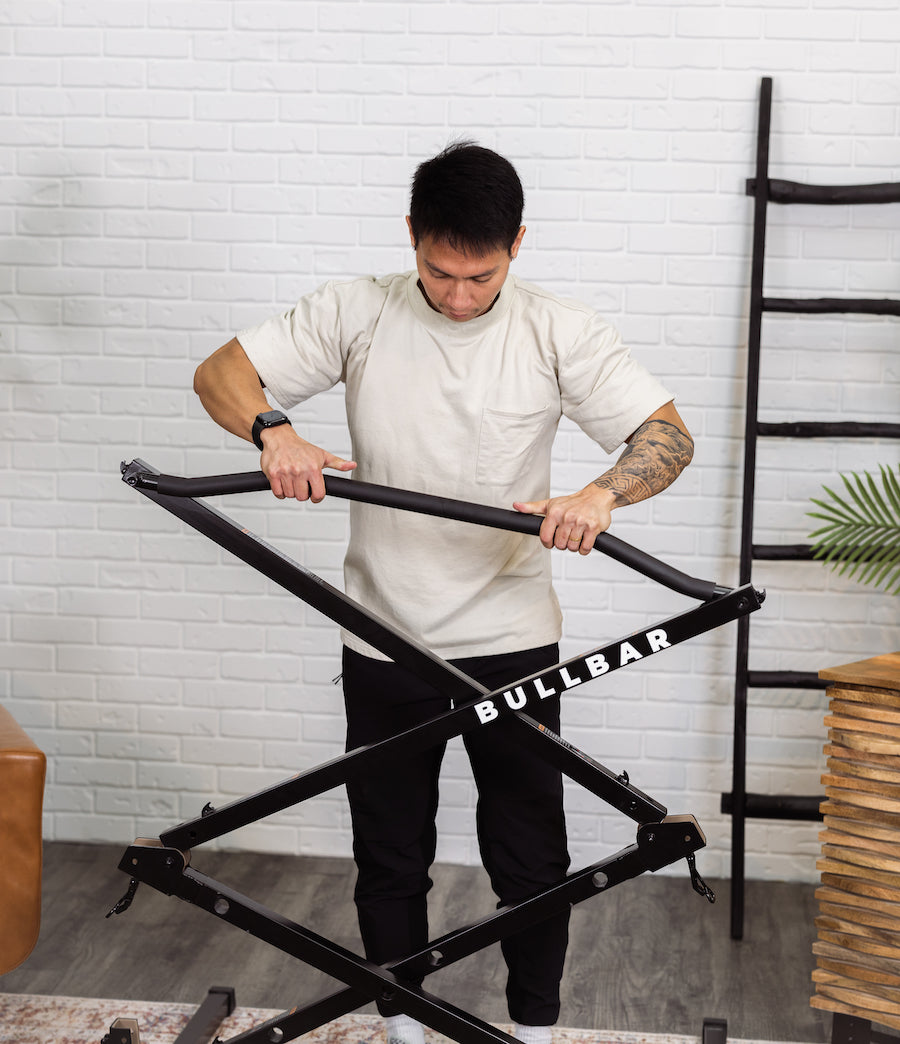
The BULLBAR 2.0 includes two dip bars with 21 to 24 inches of adjustable width and three height settings. You can set the bars high enough to clear your legs and loop a band under your knees for assisted reps. It sets up in under a minute without tools, holds up to 400 pounds, and folds down to 45 by 13 by 11 inches when you're done. That gives you the dip pattern without the knee pad and without a permanent rig. The built-in resistance band anchors let you train assistance without a counterweight stack.
A Progression That Carries Over
Start with the lightest band that lets you hit five to eight clean reps. Use a controlled three-second descent and a one-second pause at the bottom. Follow this sequence:
- Add a set each week until you can do four sets of six.
- Switch to a thinner band once four sets feel controlled.
- When you can do eight bodyweight dips, add volume before adding weight.
If you can't do a single band-assisted rep, start with negatives. Jump or step to the top position, lower yourself over five seconds, and reset. Do three sets of three. That builds the eccentric control the assisted machine never asks for.
The band matters less than the standard you hold. Keep your shoulders down and away from your ears. Don't let your hips shoot back. Lower until your upper arm is about parallel to the floor, then press to full lockout. Each rep should look like a free dip with the load reduced, not a knee pad bounce.
Where the Assisted Machine Still Fits
The assisted dip machine has one legitimate use: high-rep accessory work after your main dips. If you can do 15 strict bodyweight dips, using the machine for 20-rep burnout sets can add volume without wrecking your shoulders. But don't confuse that with learning to dip. Use it after you own the movement.
If your shoulders hurt during dips, stop and get assessed by a qualified professional. Pain is a signal to stop and reassess. Pushing through shoulder pain rarely ends well.
Measure What Transfers
Stop measuring progress by the number on the assistance stack. Measure the skills that matter without the pad. The markers that transfer are:
- Holding the bottom position for fifteen seconds
- Lowering yourself under control for five seconds
- Pressing from a dead stop at the bottom
The assisted dip machine made the movement easier by removing the constraints that made it valuable. A band and a stable dip station restore those constraints while giving you a path to your first rep. You don't need a machine to soften the climb. You need reps in the actual dip position, done consistently.
Try BULLBAR for 100 days, risk-free. Free 3 to 5 day U.S. shipping and a lifetime limited warranty. Get the BULLBAR 2.0 here.
Share
