



The Bench Dip Wasn't a Beginner Movement: A Better First Progression for Women
The bench dip is the first progression most women get handed. It's also the one that stalls their progress the most. Before you fix the movement, it helps to know where that advice came from.
Parallel bars appeared in early 19th-century German gymnastics, usually credited to Friedrich Ludwig Jahn. Gymnasts trained support holds, pressing, swings, and body control on those bars. The dip was one of the first movements taught. It predates the bench press by about a century as a pressing pattern.
In the physical culture era, women trained bodyweight pressing and support skills long before commercial gyms split routines by gender. Circus strongwomen like Katie Sandwina built entire acts around overhead lifts, pressing, and body control in the early 1900s. The movement was never gendered. The modern split came from gym marketing and equipment layout.
How the Bench Dip Became the Default for Women
In the 1970s and 1980s, commercial gyms expanded and beginner programs often separated by sex. Men went to bench presses and dip stations. Women were handed isolation machines, dumbbell kickbacks, and bench dips. The bench dip fit the small corner of the gym where women's training was often confined. It needed no equipment, no spotting, and no upper-body support.
That history still shows up. A woman who asks how to train her arms still gets a bench dip before a parallel bar dip. The bench dip is easy to feel. That doesn't make it the right progression.
Why the Bench Dip Fails as a First Step
The bench dip places your hands behind you on a bench with your feet on the floor and your torso upright. The movement asks for shoulder extension with the arm behind the body and some internal rotation. That position limits depth and takes the shoulder joint to an end range many beginners find uncomfortable. It also removes the need for scapular depression, the ability to pull the shoulder blades down while the body moves. That scapular control is the skill that makes a parallel bar dip safe and strong.
You can knock out twenty bench dips with shrugged shoulders and a stationary torso and never learn the full dip pattern. The movement becomes a triceps pump with a tucked chin. A parallel bar dip teaches a different position. The torso stays upright or slightly forward, the shoulder blades travel through depression and slight protraction, the elbows bend to a controlled depth, and the whole trunk stays rigid while the feet stay planted.
What You're Actually Training
The dip is a compound pressing movement. It recruits the chest, shoulders, and triceps in one pattern and demands that the trunk stay rigid while the body moves. You build a support position that carries over to handstands, push-ups, and overhead work.
Pressing studies consistently measure high activation in the triceps and chest during dips. You're building a position that transfers to every pressing movement you'll ever learn.
A First Progression That Works
Use a parallel bar dip station, a freestanding dip station, or adjustable dip bars. The progression I use with beginners starts with a support hold, not a bench dip.
- Support hold. Grip the bars at shoulder width or slightly wider, lock your elbows, depress your shoulder blades away from your ears, and hold for 15 to 30 seconds. Keep your neck long and your torso braced. Build to 3 sets of 20 to 30 seconds.
- Negative dips. Step or jump to the top position, then lower over 3 to 5 seconds. Keep your elbows tracking back, not flaring wide. Step down and repeat. Do 3 to 4 sets of 3 to 5 reps. This teaches the descent path.
- Band-assisted dips. Loop a resistance band under your knees or feet and anchor it to the bar or built-in band anchors. The band supports the bottom of the rep, where you are weakest. Do 3 to 5 sets of 5 to 8 controlled reps. Stop when the band starts throwing you up.
- Range-limited dips. Set a bench or box under you and lower only until your feet touch it. Over weeks, lower the bench until you take the full range. This lets you own depth without failing.
The 52 Percent Number in Context
A 1993 study in the European Journal of Applied Physiology reported that untrained women had about 52 percent of men's upper-body strength and 66 percent of men's lower-body strength. That number gets repeated as if it were a fixed rule. It isn't. It's a snapshot of untrained people. Women who train pressing and pulling movements consistently make relative strength gains comparable to men.
The limiting factor in the first dip is practice in loaded shoulder extension and support positions. If you can hold a support for 30 seconds and lower through a 5-second negative, the raw material for a band-assisted dip is already there. The first full rep follows.
Equipment That Keeps You Honest
A dip station needs two things: stability and full range of motion. It needs to be solid enough that you trust it during a negative. A freestanding frame with an open portal design gives your torso room to move without a back pad or center post in the way. That range of motion matters.
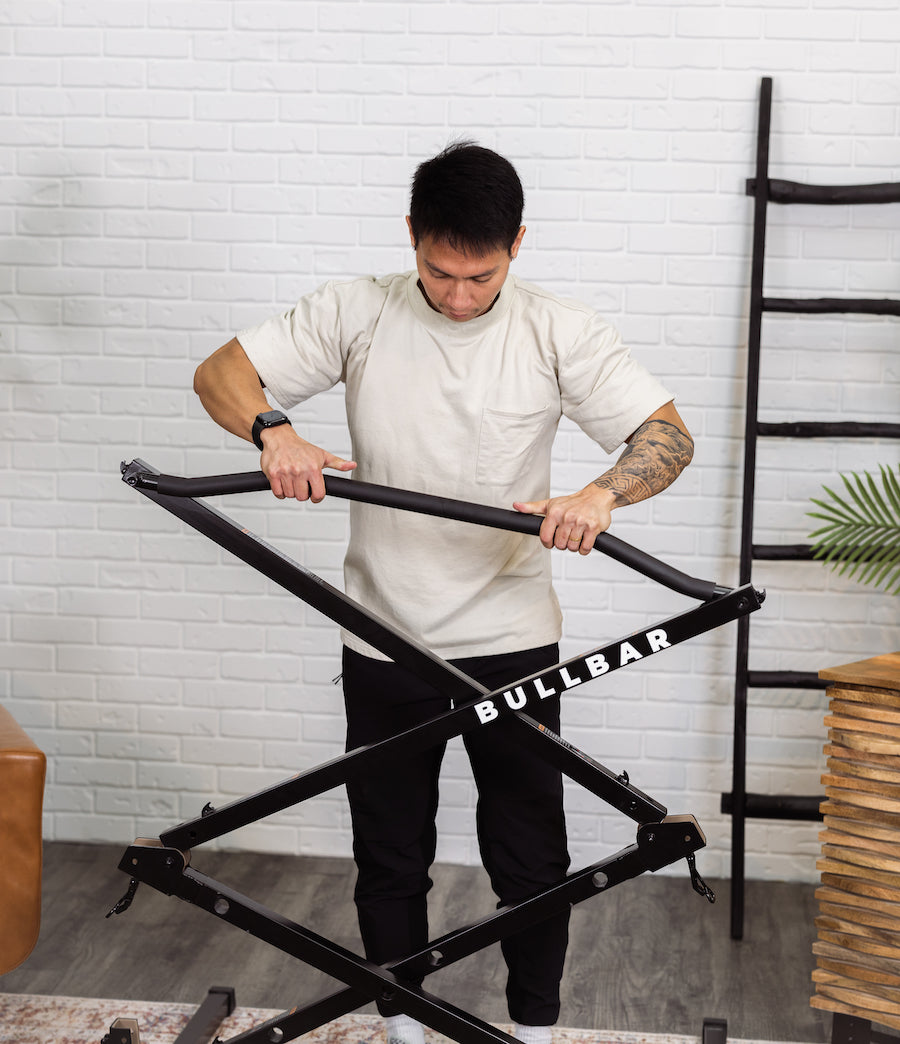
The BULLBAR 2.0 is a freestanding pull-up bar and dip station with dip bars included. The dip bars are 33.5 mm in diameter, adjust from 21 to 24 inches apart, and offer three height settings. The whole frame is tested under 400 lbs for over 1,200 continuous rep cycles. It folds down to 45 by 13 by 11 inches, so it lives in a closet when you are not training. No walls, no drilling, no permanent footprint.
Try BULLBAR for 100 days, risk-free. Free 3 to 5 day U.S. shipping and a lifetime limited warranty.
Start with 10 Minutes
You don't need twenty reps on day one. Start with 10 minutes. Hold the support position, do three controlled negatives, and stop while the movement still feels clean. Consistency beats intensity. The first full dip shows up after weeks of practice, not after one grueling workout.
You weren't built in a day.
Share
