



Why Kneeling on a Pad Won't Teach You to Dip
Walk into most commercial gyms and you'll find the assisted dip machine sitting near the cables. Kneel on the pad, pick a pin, press through the guided handles. The pitch sounds reasonable: take some weight off your body and build the dip before you can lift all of yourself.
The machine doesn't just subtract weight. It braces your torso, locks your hips, and turns a free-body dip into a seated press while kneeling. You get better at the machine. The floor doesn't care.
The Machine Takes Away More Than Weight
When you load a counterweight, the machine doesn't simply take pounds off your body. It also changes where your body can go. The pad travels on a fixed rail. The handles move through a set arc. Your torso stays vertical. Your core just sits there.
In a real dip, your hands stay planted while your torso moves through space. Your shoulder blades glide along your ribcage. Your trunk leans forward, your core resists extension, and your glutes help keep your lower body stable. The movement isn't just pressing. It's a coordination problem solved under your own center of mass.
A counterweight platform removes most of that coordination problem. That's why people can pin the stack at 60, 70, or 80 pounds of assistance for months and still shake apart when they try one full rep on parallel bars.
A Dip Is a Skill, Not Just a Press
EMG data has repeatedly shown that dips performed with a forward lean and full range of motion light up the triceps and lower chest better than a vertical machine track. The assisted version changes both of those variables.
Here's what the machine quietly removes:
- Your torso stays vertical, so the lower chest doesn't get the forward lean that makes dips work
- The pad braces your hips, so your abdominals don't have to resist extension
- The handles move for you, so the small stabilizers around your shoulder joint go quiet
What you're left with is a partial press in a braced track. It still builds pressing strength. It just doesn't build the skill of holding your own body stable in space. No one fails a dip because their triceps are weak in a straight line. They fail because their shoulders, trunk, and hips won't cooperate when the support is gone.
Why the Pin Position Stalls
This pattern repeats in gyms everywhere. A lifter starts with 50 pounds of assistance and works up to sets of 12 or 15. The pin moves down over a few weeks. Then it stops. They're stuck at the same counterweight, and a full dip still feels miles away.
The pin stalls because the machine isn't teaching the missing piece. It's letting you accumulate reps without balance, without torso control, and without the lean that connects your chest to the movement. More reps in that braced groove don't transfer to more control over your own body. The pin position measures how much weight the machine spared you. It doesn't measure how close you are to a strict full dip.
Band Assistance Keeps the Free Torso
Bands solve the problem differently. When you loop a resistance band under your knees or feet, the band gives you the most help at the bottom, where dips are hardest, and less help at the top, where you should be strongest. That's a useful strength curve.
The band doesn't lock your torso. It doesn't fix your hips. It doesn't decide the path of your arms. With a band, you still have to lean forward enough to load your chest. You still have to keep your ribs stacked over your pelvis. Your shoulder blades still move through their natural rhythm. The band only adds assistance. It doesn't remove the skill.
That's why a lifter who can do ten clean band-assisted dips with a light band is usually closer to a full rep than someone who pins 60 pounds on the machine for fifteen.
A Progression That Actually Transfers
If your goal is your first full dip, skip the machine or use it sparingly. Use these steps instead.
- Negative dips. Get to the top of the dip by stepping or jumping. Lower yourself as slowly as you can, aiming for a three to five second descent. Accumulate four to six slow negatives.
- Isometric holds. Hold the top position with straight arms and active shoulders for 10 to 20 seconds. Then hold the bottom position, or the spot just above parallel, for as long as you can control. Short holds teach your shoulders and trunk to stay organized under tension.
- Band-assisted dips. Loop a band under your knees or under one foot. Do full dips with the band, keeping your torso leaning forward and your elbows drifting slightly back as you descend. Use a band thin enough that the final two reps are hard.
- Full reps. When you can do eight clean band-assisted dips with a light band, test a full dip. Lower yourself under control. If you get stuck, turn it into a slow negative and climb back up. That's a rep earned.
When the Assisted Machine Still Helps
The assisted dip machine isn't useless. It can be a stepping stone for someone who carries a lot of extra body weight and finds full negatives too harsh on the shoulders. It can also provide volume for someone who is already strong at dips but needs to add pressing work without trashing their elbows.
The key is to treat it as a supplement, not as the main path. If you rely on it as your primary dip progression, you'll build a machine press pattern and call it a dip. Those are different movements.
Skill-First Dips on a Freestanding Station
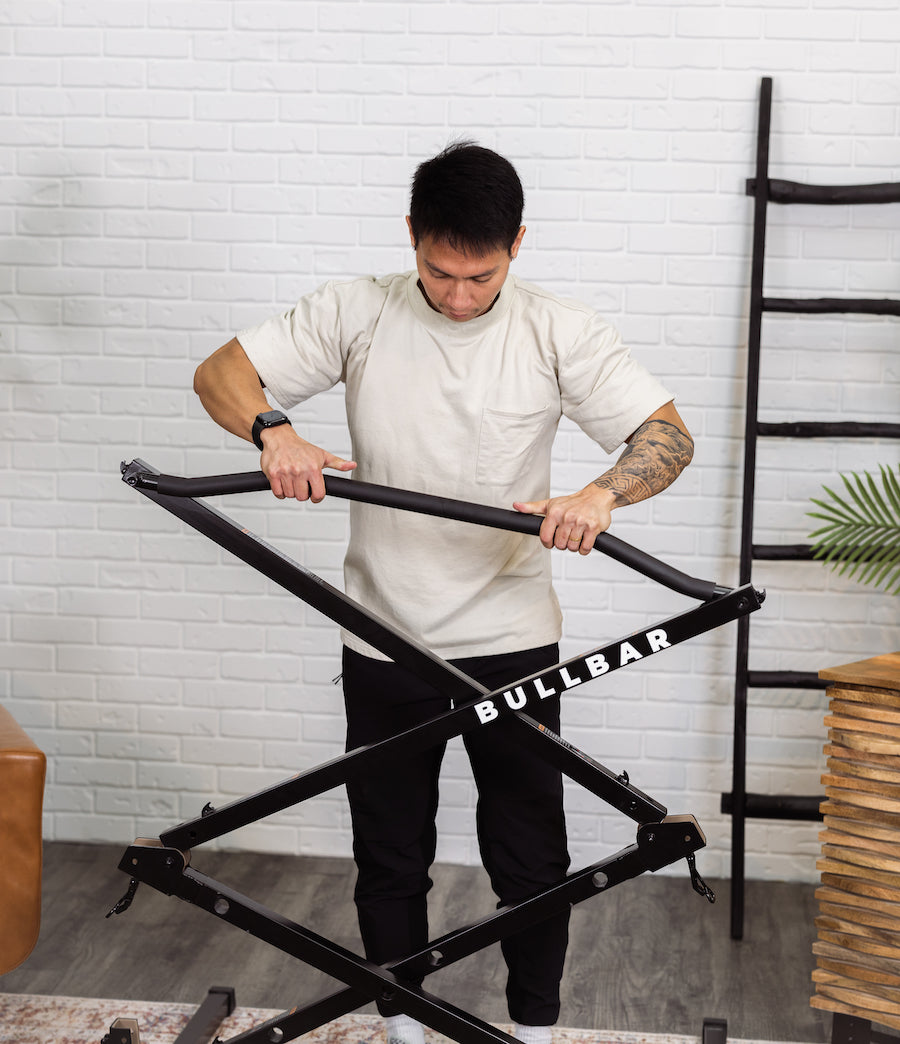
If you want a training tool that keeps the skill in the movement, the BULLBAR 2.0 portable pull-up bar and dip station gives you parallel dip bars, a steel frame tested under 400 pounds through more than 1,200 continuous rep cycles, and no center post to hit your knees. The open portal design leaves room for your torso to lean forward naturally. Clip a band to the built-in resistance band anchors, loop it under your knees, and you get assistance that preserves the free-body skill. When you're ready to test a full dip, there's no stack to rack. You're already suspended over your own hands.
That's where the real progress lives. Reps that force you to hold yourself together build the skill. The pin only lightens the load. Try BULLBAR for 100 days, risk-free. Free 3-5 day U.S. shipping and a lifetime limited warranty.
Share
