



Dips Built Front Delts Long Before Machines Split the Shoulder
Your front delts have been quietly demoted. Walk through most gyms and the anterior deltoid gets a cable station and a pair of light dumbbells while dips get logged as a chest and triceps move. That split costs you shoulder strength. It also hides what the front delt actually does.
The anterior deltoid originates on the lateral third of the clavicle and inserts on the deltoid tuberosity of the humerus. Its job is shoulder flexion, lifting the arm forward and up. During a dip, the shoulder starts in extension at the bottom, and the anterior deltoid has to flex the humerus forward against the full weight of your body before the triceps and chest finish the lockout. The bottom third of the rep asks the most because the humerus travels from behind the body back to neutral. A front raise trains the same arc with a light weight and an open chain. A dip trains it with your body weight and a closed chain.
Load changes everything.
How the Dip Ended Up on Chest Day
Before selectorized shoulder machines, dips sat next to presses and chin-ups in serious training programs. Gymnasts, bodybuilders, and weightlifters built their shoulder girdles around support holds and pressing. Nobody carved out a separate front delt day because heavy pressing and dipping already covered it. Then pin-loaded shoulder machines arrived and equipment makers split the shoulder into front, side, and rear categories. Dips got re-shelved under chest and triceps. Front delts got sent to isolation raises.
The split was a convenience for equipment marketing. The underlying anatomy never changed.
Why the Front Raise Falls Short
A front raise has a poor strength curve. The resistance feels hardest at the top, where the shoulder is shortened and at a mechanical disadvantage. The weight a front raise can handle is limited by that weak top position. That is not enough tension to force growth in a trained shoulder.
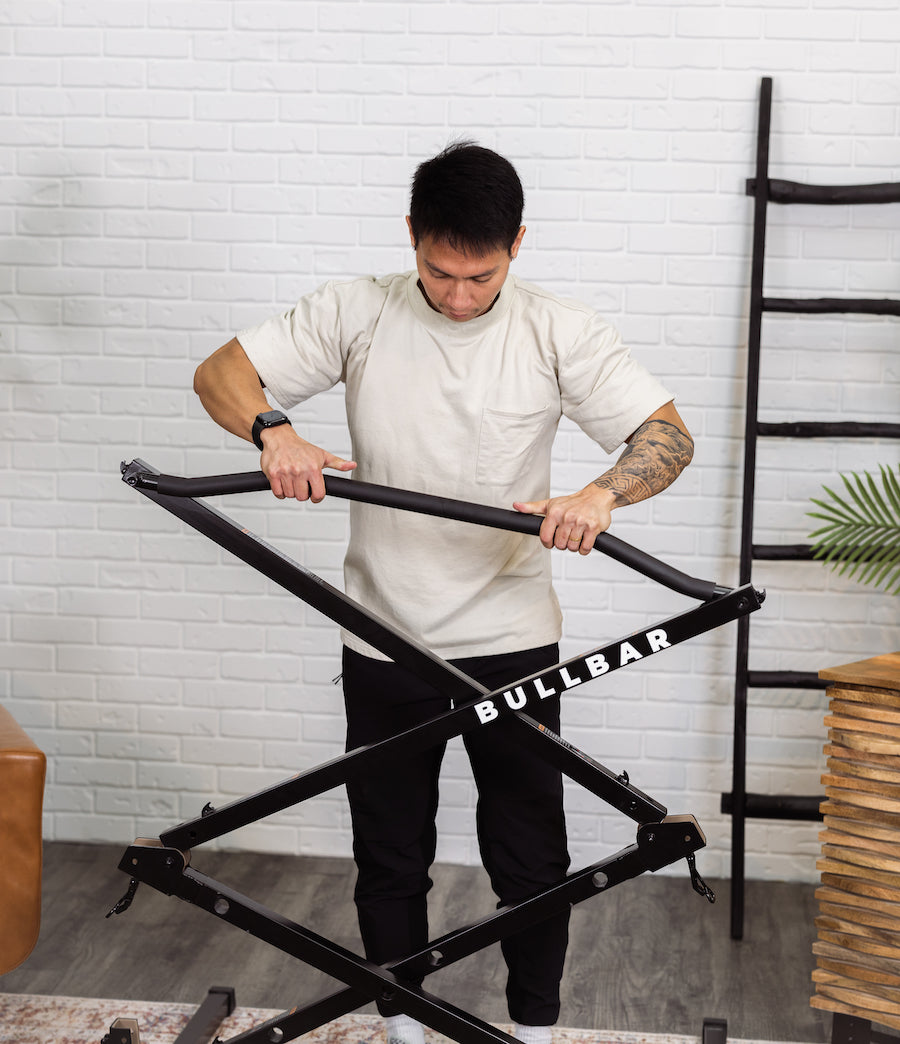
A dip solves the load problem. Your body weight loads the upper body, and a dip belt adds more. The BULLBAR 2.0 is rated to 400 pounds, which leaves room for years of progressive overload beyond what any cable stack can deliver. Dips also force the front delt to work alongside the pecs and triceps. That is how pressing gets strong.
Programming Dips for Front Delt Growth
Dips are not automatically safe for every shoulder. Depth, tempo, and torso angle decide whether you build the front delt or grind down the joint.
- Start with support holds. Lock your arms, pull your shoulder blades down away from your ears, and hold for 20 to 30 seconds.
- Move to slow negatives. Lower yourself over five seconds, step back up, and repeat. Five controlled negatives per set is enough at first.
- Progress to full reps once five clean negatives feel easy. Keep the range pain free.
- Add load when you can complete three sets of ten strict reps. Use a dip belt or a weighted vest.
Torso angle matters. A slight forward lean keeps the front delt involved while protecting the shoulder. A fully upright dip shifts more work to the triceps. A severe forward lean shifts more to the lower chest. Train in the middle. Stop one set before your shoulders roll forward or your elbows flare.
If you have a history of shoulder pain, limit depth to a range you control. Train with a qualified coach or physical therapist when pain shows up.
What a Freestanding Station Changes
Most power towers force you to dip against a back pad or a center post. That setup limits torso position and range. An open portal design leaves the space in front of your body clear. The BULLBAR 2.0 uses that design, with dip bars that adjust from 21 to 24 inches apart and offer three height settings so you can match the setup to your arm length and shoulder history.
The frame is 16-gauge industrial steel and folds down to 45 by 13 by 11 inches. The quick-release toggle latch system lets you set it up and fold it down in under a minute, with no assembly, no drilling, and no wall mount. That matters for front delts because strength comes from consistency, not one heroic session. A station that stores out of the way removes the barrier between intention and training.
Put Dips Back Where They Belong
Front delt training needs a return to heavy, closed-chain shoulder flexion. Put dips back in your program and give them the same priority as presses. Let front raises serve as finishing work if you want them. Your front delts will show the difference in pressing strength and muscle density.
Try the BULLBAR 2.0 for 100 days. Free 3-5 day U.S. shipping and a lifetime limited warranty sit behind it. If dips do not change your front delt training, return it.
Share
