



Stop Treating Dips as a Chest-Only Exercise: The Lat's Real Job in Every Rep
The dip has spent decades filed under chest day. That label misses half the movement. As you lower between the bars, your upper arm travels behind your midline. That action is shoulder extension. The latissimus dorsi works as a shoulder extensor, so it contracts on every rep whether you cue it or not. If you treat the dip as a pure pressing movement, you leave that lat activation to chance. Chance is not a training plan.
I have spent years reading anatomy texts and watching lifters train this movement. Most of them grip the bars, bend their elbows, and chase the burn in their chest and triceps. The lats get left out. Here is what I learned once I started paying attention to them.
What the Lat Actually Does During a Dip
Anatomy texts list three actions for the lat: shoulder extension, adduction, and medial rotation. Two of those show up in a full-range dip. Lowering into the bottom position extends the shoulder. Your arm also moves slightly toward your side, which is adduction. The pecs and triceps generate most of the upward force, but the lat manages the bottom of the movement and keeps the shoulder from collapsing upward. That stabilization role is not flashy. It is the difference between a controlled rep and a loose one.
Slow down your next set. Lower yourself for three seconds and pause just below parallel. You will feel the sides of your back switch on as you hold the position. That is the lat doing its job.
The Mistake Most Lifters Make
When the lats go slack during a dip, the shoulder girdle rises toward your ears. The humeral head drifts forward, and the press becomes a fight between your triceps and a loose joint. Some lifters notice a pinch at the front of the shoulder when that happens. A fast, bouncy dip hides the problem. A slow dip exposes it. If you cannot hold the bottom position without your shoulders creeping up, your lats are not engaged.
That missing tension matters for more than shoulder health. A lat-conscious dip builds strength in the exact position where the shoulder extends under load. Pull-ups start from that same extended position. Muscle-up transitions demand it. If you train dips without lat engagement, you miss a chance to build carryover to every vertical pulling movement you do.
How to Cue Lat Engagement in Your Dips
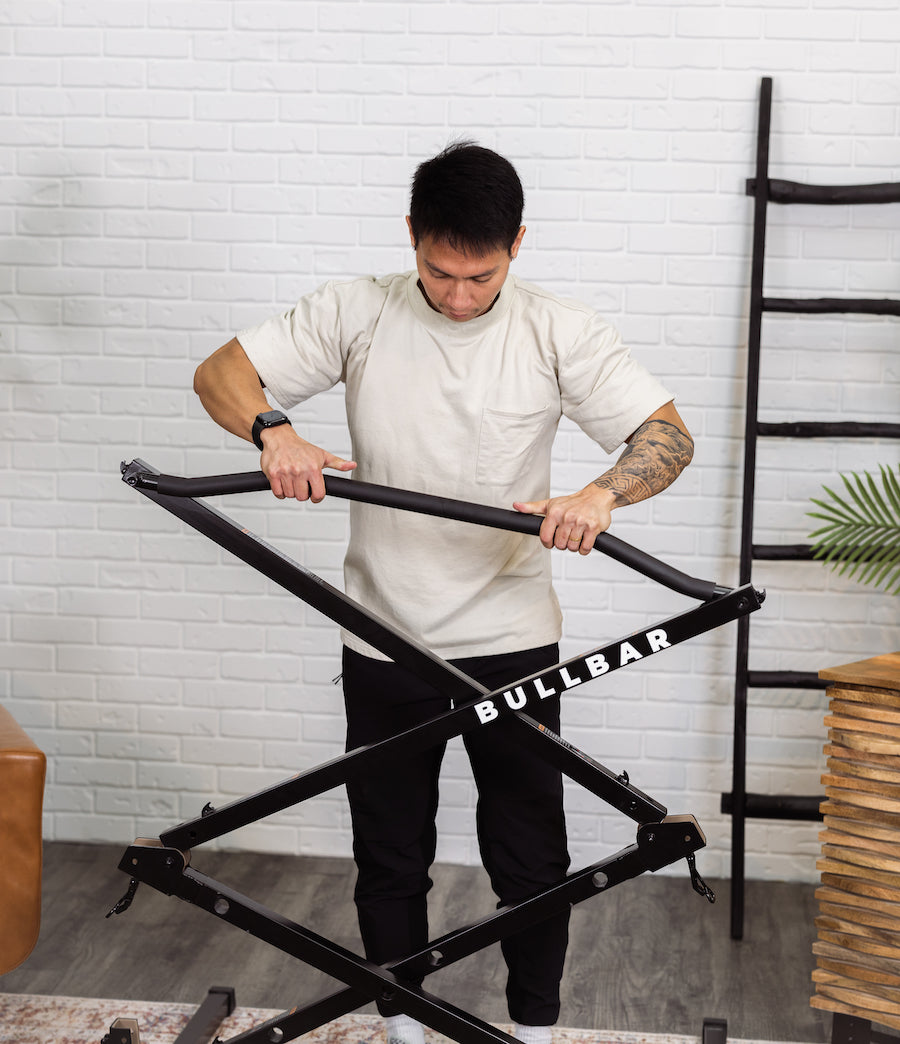
Set your hands about shoulder width apart. On a BULLBAR 2.0, the dip bars adjust from 21 to 24 inches apart and offer three height settings. Choose a width that lets your wrists stay stacked under your shoulders. Before you lower, pull down through your hands as if you were trying to drag the bars toward the floor. You should feel the sides of your back switch on. Keep that tension and bend your elbows. If you lose the pull, your shoulders start to rise. Reset at the top.
Lower for three seconds. Keep your shoulder blades depressed the entire time. At the bottom, pause for two seconds. Then press through your palms. The press should feel like you are pushing the bars into the ground while your lats hold your shoulder in place. If your shoulders start creeping toward your ears, you lost the lat. Stop the set and re-establish tension.
The open portal design on the BULLBAR 2.0 helps here. There is no center post or back pad to interrupt your range, so you can lower into a full dip without leaning around a frame. You get a complete range of motion, which is exactly what the lat needs to perform its stabilization role.
Progressions to Build Lat Awareness
If you have never trained the dip with lat tension, start with isometric holds. Lower to just below parallel and hold for 10 seconds while actively pulling the bars toward your hips. This builds isometric lat strength in the exact range where most people dump tension. Do two or three holds after your dip sets.
Once you can hold the bottom position without your shoulders rising, progress to slow eccentrics. Lower for three seconds, pause for two, press up under control. Ten slow reps beat twenty bouncy ones. The slow eccentric forces you to maintain tension through the entire range, and the pause at the bottom makes any slack obvious.
For intermediate and advanced lifters, add a pause to every weighted dip. The extra load increases the demand on the lat's stabilizing role. If you cannot maintain tension with added weight, drop the load and rebuild the pattern. A heavy dip with sloppy shoulders does not build what you think it builds.
Programming Dips with Pull-Ups for Back Development
A pull-up trains the lat as a prime mover. A dip trains it as a stabilizer and shoulder extensor. Pairing them in the same session covers both jobs. On the BULLBAR 2.0, the pull-up bar and dip bars live on the same freestanding frame. You can move from one movement to the next without waiting for a rack or rearranging your space.
Start with four rounds: 5 strict pull-ups, 8 controlled dips, 60 seconds rest. If 8 dips gets sloppy, drop to 5. The goal is tension, not volume. Over three weeks, track whether your pull-ups feel stronger at the start of each set and whether your shoulders feel more stable at the bottom of a dip. That improvement is the result of training the lat's dual role.
If you are working toward your first strict pull-up, slow dips and bottom holds build the shoulder extension control you need. A pull-up starts from a dead hang with the shoulders extended. The dip trains that same bottom position under load, just from a different angle. Use the dip as a stepping stone, not a substitute.
What Dips Will Not Do for Your Back
Dips will not replace pull-ups or rows. They will not build the same stretch and contraction that a vertical or horizontal pull does. What they give you is a closed-chain shoulder extension demand that strengthens the lat in a supporting role. That support matters when you push for a heavier pull-up or a longer muscle-up transition. It also makes dips a better press.
So train the dip with intention. Pull the bars down before you lower. Hold the bottom. Feel your lats work. Then press with a stable shoulder. That is the difference between going through the motions and building strength that transfers.
Try BULLBAR 2.0 for 100 days, risk-free. Free 3 to 5 day U.S. shipping and a Lifetime Limited Warranty. The freestanding frame sets up in under a minute, folds down to 45 by 13 by 11 inches, and holds up to 400 pounds. No tools, no drilling, no excuses.
Share
