



The Press Before the Bench Press: Why Dips Belong in Your Bench Program
Walk into a commercial gym on a Monday and you will find a line for the flat bench. The dip station sits empty. That is a mistake if you want a bigger bench. Dips were building pressing strength long before the barbell bench press existed, and they still fix the weak points the bench press leaves behind.
The bench press is a modern invention. Dips required only two parallel surfaces for centuries. Gymnasts, soldiers, and old-time strongmen used them long before powerlifting federations formalized the three lifts in the 1960s and made the bench press the official pressing test. Since then, the bench has become the default answer to "how much do you press?" and dips got pushed aside.
But the bench press is a constrained movement. Your back stays on a bench, your scapulae are pinned, and your shoulders move through a fixed path. Dips allow the shoulder blades to move, the torso to lean, and the elbows to find a position that suits your anatomy. That difference matters for carryover.
What the Bench Press Leaves Untrained
The bench press rewards pec strength, anterior deltoid strength, and triceps strength. It does not demand much from the serratus anterior or the lower traps. It does not train pressing while the shoulder blade moves. Dips do both. When you lower into a dip, the shoulder blade tilts and the chest stretches under load. When you press out, the triceps finish the lockout. That combination is the missing stimulus for many stalled benches.
Electromyography research comparing the two movements has documented high triceps activation during dips and meaningful lower-pec involvement. A dip with a forward torso lean shifts the emphasis toward the lower chest, much like a decline press. The bench press cannot replicate that full shoulder blade movement.
How Dips Carry Over to the Bench
A bench press fails at three points: off the chest, mid range, and lockout. Lockout failures are often triceps failures. Dips train elbow extension against heavy load through a full range. Weighted dips load the triceps in a way close-grip bench does not, because the upright torso position demands constant triceps tension. Add dips and lockout strength improves.
The long head of the triceps crosses the shoulder joint and contributes heavily when the shoulder is flexed, as it is during dips. That matters for lockout, because the long head helps stabilize the elbow under load. If your bench press stalls halfway up, the triceps are the usual weak point. Dips address that directly.
The bench press pins the scapula for stability. That stability helps you move heavy loads, but it also removes the scapular contribution to force production. Dips train the shoulder to press while the scapula moves. That builds the kind of strength that transfers to any pressing movement, including the bench. You get better at producing force through a moving shoulder complex, and that shows up when you return to the barbell.
Programming Dips for a Bigger Bench
Start with bodyweight dips if you can do 8 clean reps. Use a band for assistance or perform slow negatives if you cannot. Progress to weighted dips once you own 3 sets of 10 bodyweight reps. Add small plates at a time. Five pounds is enough.
Frequency: twice per week.
- Day 1: Heavy dips, 4 sets of 5.
- Day 2: Volume dips, 3 sets of 8 to 10.
Keep the bench press in your program. Dips work as an accessory, not a replacement. They build the lockout and the lower pec.
A sample 8-week progression:
- Weeks 1 through 2: Bodyweight, 3 sets of 8.
- Weeks 3 through 4: Add 5 to 10 pounds, 4 sets of 6.
- Weeks 5 through 6: Add 10 to 20 pounds, 4 sets of 5.
- Weeks 7 through 8: Add 20 to 25 pounds, 5 sets of 5 or 3 sets of 8.
This cycle treats the dip as a skill. Consistency wins here. Slow added weight beats fast sloppy reps.
Equipment That Won't Get in the Way
A dip station that wobbles or forces a narrow grip will limit how much you can load. Doorway bars cannot support weighted dips. Many power towers have fixed handles that may not match your shoulder width and a center post that gets in the way.
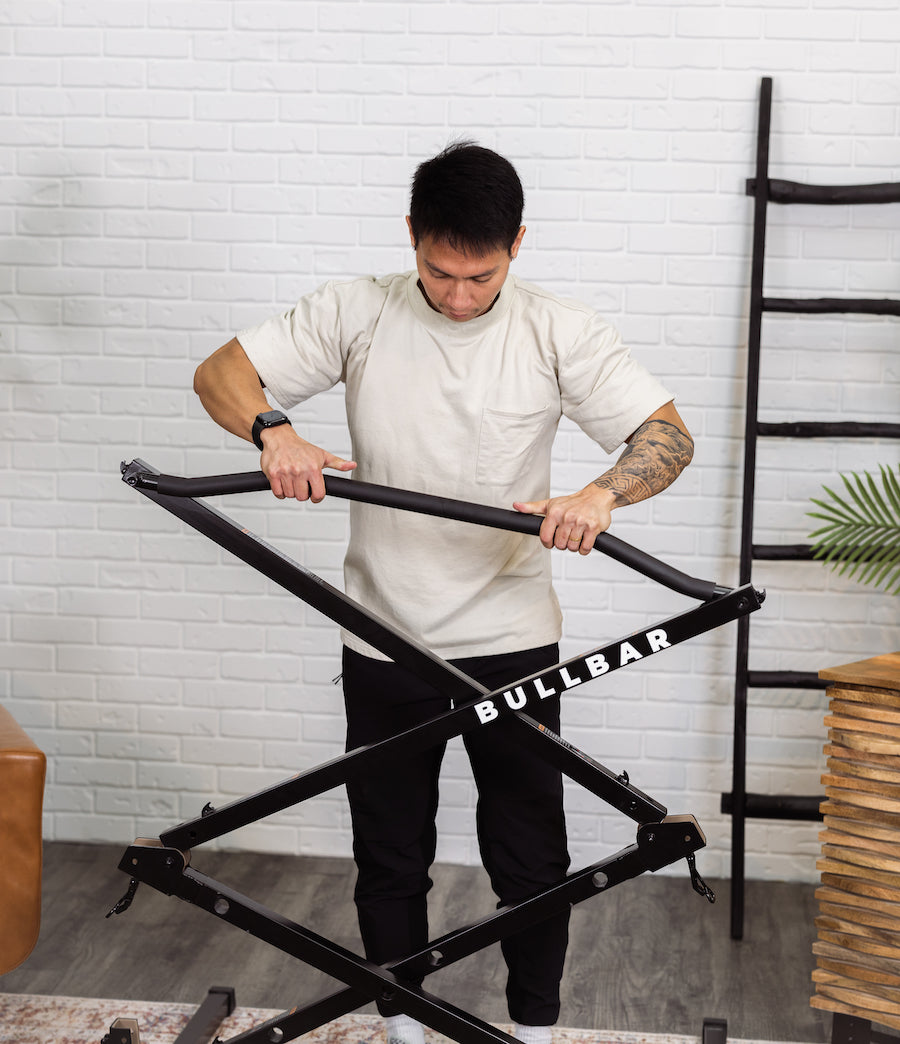
Look for a freestanding unit with adjustable dip bars and no center post. The BULLBAR 2.0's dip bars adjust from 21 to 24 inches and handle up to 400 pounds, so you can add weight without the setup fighting you. The open portal design leaves room for your head and chest at the bottom of the rep. That stability matters when the plates start adding up. You can find it here: BULLBAR 2.0.
Mistakes That Drain the Carryover
- Leaning too far forward: A slight forward lean is fine. A full push-up position shifts the work to the chest and shoulders and takes tension off the triceps.
- Bouncing out of the bottom: Control the descent. Pause for half a second at the bottom before pressing.
- Adding weight before owning bodyweight: If your bodyweight reps are shaky, loaded dips will be worse.
- Ignoring shoulder pain: Dips demand mobile shoulders. If you have pain, get it checked before adding weight.
If you want a bigger bench, stop ignoring the dip station. Add weighted dips twice a week and give it eight weeks. Expect the lockout to improve first. Then watch the full press follow.
You weren't built in a day, and your bench press won't be either. If you need a dip setup that folds flat and stores in a closet, try BULLBAR for 100 days risk-free. Free 3 to 5 day US shipping and a lifetime limited warranty.
Share
