



Why Your Shoulders Hurt on Dips and How to Fix It
Somewhere along the way, dips picked up a reputation as a shoulder destroyer. You hear it from well-meaning gym regulars, read it in comment sections, and occasionally get it from a healthcare provider. The warning comes with the weight of a courtroom verdict: skip dips if you value your shoulders. Yet gymnasts, old-time strongmen, and anyone who trained on parallel bars for the last hundred years built thick chests and triceps without widespread impingement complaints. So what changed? Not the human shoulder. The training culture around the dip changed.
Dips Have Been Around Longer Than Your Gym Membership
Physical culture manuals from the early 1900s list parallel bar dips right next to pull-ups and push-ups as core calisthenics. Greek athletes used bodyweight pressing to prep for wrestling and pankration long before barbells existed. The movement never disappeared from gymnastics or military training. It just fell out of favor in mainstream gyms when the bench press became the default measure of upper-body strength in the 1980s and 1990s. Machines multiplied, adjustable benches replaced parallel bars, and the dip quietly moved to the corner.
When dips came back in the early 2000s, they came back without the coaching that used to accompany them. Functional fitness and bodyweight training surged in popularity. People who had spent years chasing bench numbers decided to add weighted dips to their programs. The problem? No progression, no scapular awareness, no attention to depth. Just load and ego. Shoulder pain followed, impingement diagnoses piled up, and the dip took the blame.
The Anatomy of Dip-Related Shoulder Pain
Your shoulder joint is a ball sitting in a shallow socket. Above it sits a bony shelf called the acromion. Between them runs the subacromial space, home to the supraspinatus tendon, part of the biceps tendon, and a bursa. If your scapula tilts and rotates correctly while your humerus moves into extension behind your torso, the subacromial space stays open enough for the supraspinatus tendon and bursa to move without getting pinched. If your shoulder blade shrugs up and rolls forward instead, that space closes. The tendon gets pinched. Repeat that pinching for months and you get irritation, inflammation, and pain.
That mechanism is not unique to dips. Overhead pressing, bench pressing, and even push-ups done badly can close the same space. The dip catches more blame because it demands more shoulder extension than most pressing movements, and because people tend to chase depth before their shoulders are ready. The exercise did not change. The preparation did.
The Real Culprits Behind Shoulder Pain
When someone reports shoulder pain during dips, the first questions rarely involve the dip itself. They involve movement quality far away from the parallel bars. Can you reach overhead without your lower back arching? Can you hold your shoulder blades down and back while hanging? Can you bang out ten push-ups without your traps crawling toward your ears? If the answer is no, the dip is not the problem.
- Thoracic mobility deficits: If your upper back cannot extend, your shoulders cannot move through full range without compensation. The scapula gets stuck and the humerus grinds.
- Weak scapular control: The muscles that pull your shoulder blades down and back lag behind the big pressing muscles. When you dip, the joint absorbs force the muscles should handle.
- Ego-driven depth: A full dip drops the upper arm below parallel. That position takes months to earn. Most people skip straight to it.
- Unstable setups: Two wobbly chairs or a flimsy doorway station force your shoulders to stabilize you, not just press. Extra work shows up as tightness and poor mechanics.
- Elbows flared wide: Shoulders internally rotated and elbows out place the humerus in the worst position for the subacromial space.
How to Keep Dips in Your Training Without Wrecking Your Shoulders
None of these factors are permanent. You can fix every one of them and keep dips in your program for decades. The path is straightforward, which is exactly why people ignore it. They want the shortcut. The shortcut is the problem.
- Start with support holds. Hold the top position for 30 seconds with shoulders down and chest tall. If your shoulders creep up, you are not ready for full reps.
- Use negatives. Jump or step to the top, lower as slowly as you can control, then reset. Three to five sets of three reps build the eccentric strength tendons need.
- Limit your range. Upper arm parallel to the floor is a legitimate stopping point. Add depth over weeks, not days.
- Tuck your elbows. Keep them 30 to 45 degrees from your torso instead of flared out to the sides.
- Engage your shoulder blades. Shrug them down and back before you descend and hold that position through every rep.
- Choose neutral grips when possible. Palms facing each other places the shoulder in a more externally rotated position, which opens the joint.
- Respect sharp pain. Muscle soreness is fine. Pinching in the front of the shoulder is a signal to stop and reassess.
Equipment That Doesn't Fight You
Here is where the home training boom gets interesting. Bodyweight movements are perfect for small spaces, but only if the equipment is stable. Two wobbly chairs, a cheap doorway station, or a power tower with a center post in the way all compromise form. That compromised form creates the very impingement people blame on the movement.
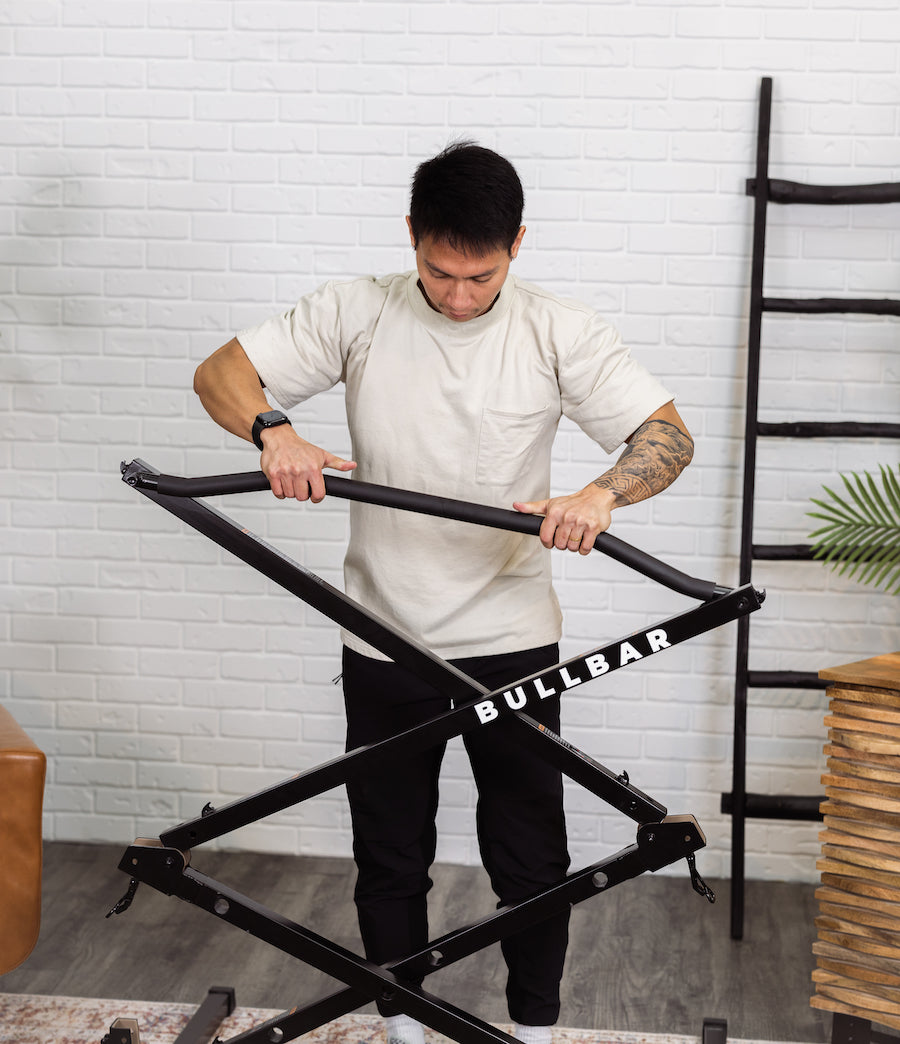
A freestanding dip station with a solid base and adjustable width solves the stability problem outright. The BULLBAR 2.0's dip bars adjust from 21 to 24 inches apart and sit at three heights, so you can find a position that matches your shoulder mechanics instead of forcing your body into whatever a flimsy station allows. The whole unit sets up in under a minute, folds down to 45 inches by 13 inches by 11 inches, and supports up to 400 pounds. That stability matters more than most lifters realize. Give the shoulder a solid base to work from and half the problem disappears.
Check out the BULLBAR 2.0 here. It ships free in the U.S., comes with a 100-day trial, and includes a lifetime limited warranty.
Put the Blame Where It Belongs
Dips have built strong, healthy shoulders for generations. They did not become dangerous. We stopped respecting the progression. Shoulder impingement is a real problem and deserves real attention: mobility work, scapular control, gradual loading, and honest self-assessment. It does not deserve a convenient scapegoat in the form of an exercise that, done correctly, remains one of the most effective upper-body movements you can do.
Next time someone tells you dips will destroy your shoulders, ask what their last three months of dip training looked like. If the answer involves random sets, max depth, and zero progression work, you will know where the problem lives.
The dip works fine when you respect it. Your approach is what needs fixing. Fix that and you can train this movement for years without a single day of shoulder pain.
Share
